The Magic of Seven Simple Shapes
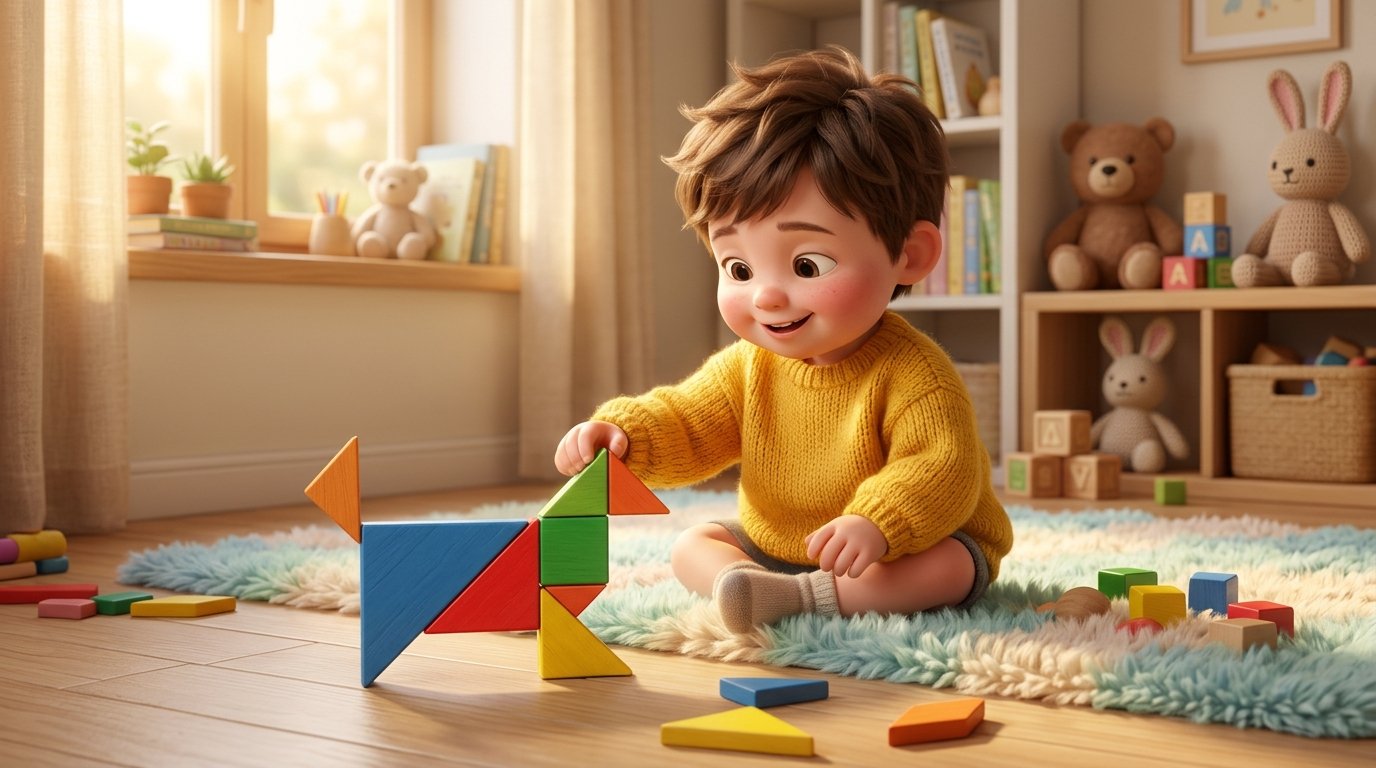
Dating back to China's Song Dynasty and popularized worldwide during the nineteenth century, the Tangram (known in Chinese as qi qiao ban, or "seven boards of skill") is one of history's most brilliant educational tools. Cut from a single square into five triangles, one square, and one parallelogram, these seven flat geometric pieces—called tans—can be rearranged into thousands of recognizable figures: sprinting foxes, soaring birds, gliding swans, and cozy houses.
For early childhood educators and parents of toddlers and preschoolers, tangrams provide the ideal bridge between freeform sensory play and formal geometric thinking. Long before a child learns the formal definitions of acute angles or congruence, their little hands discover that two small triangles join seamlessly to form a square, or combine to match a large triangle.
1. The Cognitive Science of Spatial Decomposition
When young children look at the world, their perception is initially holistic: they see a dog, a chair, or a car as a single indivisible object. Mathematical thinking begins when a child develops spatial decomposition—the ability to mentally dissect a complex composite silhouette into its constituent geometric components.
Developmental milestones fostered by tangram play include:
- Mental Rotation & Orientation: Discovering that a triangle does not change its identity when flipped upside down or rotated 90 degrees.
- Conservation of Area: Grasping that all tangram creations, whether an elephant or a sailboat, occupy the exact same total surface area as the original flat square.
- Visual-Spatial Working Memory: Holding a target silhouette image in mind while manipulating physical wooden pieces across a desk.
2. A 3-Stage Scaffolding Method for Ages 3 to 6
Throwing an abstract black silhouette at a 3-year-old often leads to frustration. Master early childhood educators use a graduated three-stage approach:
- Level 1: 1-to-1 Color Match Mats (Ages 3–4): The puzzle mat features life-sized, full-color outlines of each individual tan (e.g., the red triangle goes here, the blue square goes there). The child simply matches color and orientation on top of the template.
- Level 2: Internal Line Outlines (Ages 4–5): The animal silhouette is drawn to actual 1:1 scale with faint internal dashed lines showing where each piece fits, but all pieces are monochromatic. The child must determine which tan matches which internal section.
- Level 3: Pure Solid Silhouettes (Ages 5–6): The ultimate spatial challenge! The child is shown a solid black silhouette of a swan or rabbit and must construct the identical shape on their table without internal lines.
3. Combining Spatial Puzzles with Narrative Play
Preschoolers learn most joyfully when math is intertwined with imaginative storytelling. Try these engaging classroom routines:
- The Transforming Animal Tale: Read a storybook where a magic puppy chases a butterfly, hops into a boat, and climbs a mountain. At each story transition, children rearrange their seven tans to mirror the narrative event.
- Sensory Bin Tangram Excavation: Bury wooden or foam tangram tiles in a bin of dried rainbow rice or kinetic sand. Children dig up tiles with plastic tongs and fit them into puzzle boards.
- Chalk Silhouettes on the Playground: Draw giant tangram outlines with colorful sidewalk chalk. Children work together outdoors to position oversized foam tiles.
Building Foundational Geometric Fluency
Spatial reasoning in preschool is one of the strongest statistical predictors of high school STEM achievement. By introducing tangrams as playful storytelling adventures, we nurture confident, imaginative spatial thinkers from their earliest years.
Download free printable Tangram Animal Mats & Early Geometry Puzzle Packs on PuzzleNest today!