The Linguistic Bridge to Spatial Cognition
Before a young child can grasp kindergarten math or navigate a coordinate grid, they must develop robust spatial language. Words like over, under, through, beside, between, and around are not merely descriptive grammar; they are the fundamental cognitive coordinates children use to orient themselves in physical space, follow multi-step instructions, and organize visual information.
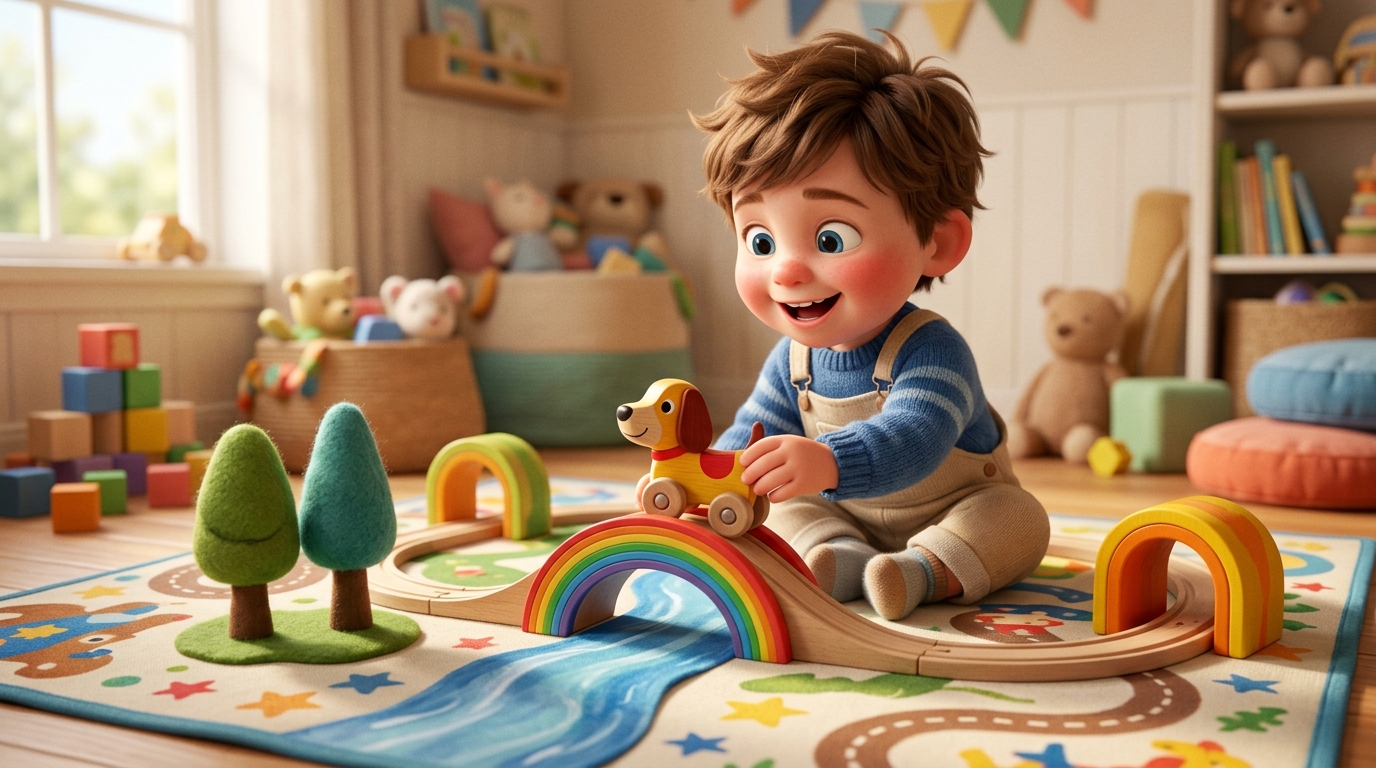
Research in developmental psychology shows that children who acquire a rich spatial vocabulary during ages 2 to 5 demonstrate significantly higher spatial reasoning and geometry achievement in elementary school. Printable storybook maze adventures provide the perfect playground for practicing positional words, turning abstract prepositions into exciting physical journeys.
1. From Physical Movement to Paper Pathways
For toddlers and preschoolers, learning begins through bodily movement. A young child understands what "under" means because they have crawled under a blanket fort; they understand "through" because they have climbed through a fabric tunnel at the playground. The developmental challenge lies in transferring this 3D physical sensation onto a 2D sheet of paper.
Illustrated story mazes bridge this developmental gap. Instead of presenting sterile geometric walls, storybook mazes present relatable narratives: "Help the friendly puppy run OVER the wooden bridge, crawl UNDER the hollow log, and squeeze BETWEEN the two tall pine trees to find its cozy doghouse." By vocalizing these spatial actions while tracing their finger along the path, children connect the physical motor movement directly to the linguistic label.
2. The Developmental Hierarchy of Positional Words
Children acquire spatial concepts in a predictable developmental sequence. Effective preschool maze activities scaffold this progression intentionally:
- Ages 2 to 3 (In, Out, On, Off): The simplest topological relationships. Mazes feature broad, open paths where characters enter in a garden gate or climb on a stepping stone.
- Ages 3 to 4 (Under, Over, Up, Down): Vertical and elevation relationships. Mazes introduce curving bridges that cross over streams and tunnels that dip under hills.
- Ages 4 to 5 (Between, Beside, Behind, Through): Complex relational prepositions. Mazes challenge the child to steer a pathway precisely between two obstacles or weave around sleepy dragons without touching them.
"When a preschooler traces their finger over a bridge and under a tree in a maze, they are not just solving a puzzle—they are anchoring the spatial grammar of their world."
3. Strengthening the Pincer Grasp and Eye-Hand Coordination
Beyond language acquisition, preschool maze adventures provide essential fine-motor preparation for handwriting. Navigating wide, curving corridors requires the child to:
- Modulate pencil or crayon pressure to avoid tearing the paper.
- Maintain visual fixation on the path ahead while coordinating hand movement (visual-motor integration).
- Exercise wrist stability and finger isolation, transitioning from a whole-hand palmar grasp to a mature 3-finger tripod grip.
4. Four Engaging Spatial Language Play Activities
- The Finger-Walking Story Time: Before handing children pencils, have them use their index finger as an animal's "paws" to walk through the maze while you narrate the spatial journey together in an animated voice.
- Tactile Yarn and Play-Dough Mazes: Have children roll snakes of colored play-dough to form the maze boundaries, or glue lengths of yarn along the paths, providing rich sensory feedback for little fingers.
- Obstacle Course Mirroring: Build a simple physical obstacle course in the classroom or living room that mirrors the paper maze. Children climb over cushions and crawl under tables, experiencing the maze with their entire bodies before tracing it on paper.
- Sticker Placement Challenges: Give children animal stickers with verbal instructions: "Place the bunny UNDER the mushroom and the butterfly BETWEEN the flowers."
Explore our wide collection of free printable Early Childhood & Preschool Storybook Mazes on PuzzleNest to inspire joyful learning in your little explorers today!