The Golden Standard of Early Childhood Manipulatives
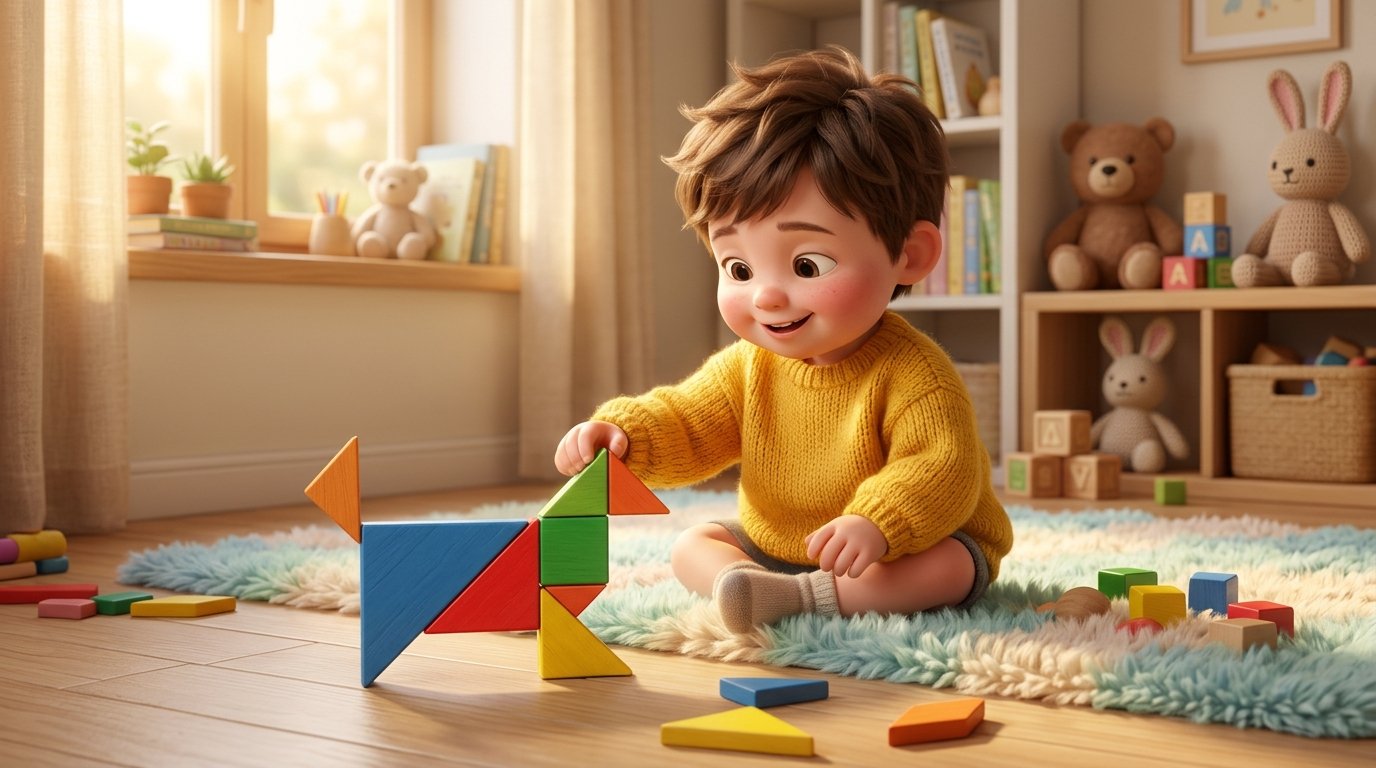
Walk into any high-performing kindergarten or Montessori classroom, and you will almost certainly spot a sturdy wooden tub brimming with brightly colored geometric tiles: yellow hexagons, orange squares, green equilateral triangles, red trapezoids, blue rhombuses, and slender tan parallelograms. Developed in the 1960s by the Elementary Science Study (ESS), standard pattern blocks remain the gold standard of early childhood mathematical manipulatives.
What makes pattern blocks uniquely genius is their precise mathematical proportionality: all angles are multiples of 30 degrees, and all sides measure 1 inch (except the long base of the trapezoid, which measures 2 inches). Because of this harmonious engineering, children can tile patterns endlessly with zero gaps, intuitively discovering angles, symmetry, tessellations, and fractional relationships through tactile play.
1. The Developmental Leap to Bilateral Symmetry
In human development, the concept of bilateral symmetry—recognizing that an object has balanced proportions on both sides of a central axis—is intimately connected to early bodily awareness and spatial orientation. Long before children understand abstract geometry, they recognize symmetry in human faces, butterflies, and leaves.
Symmetry mats provide a playful, scaffolded bridge for this understanding:
- The Butterfly Axis Challenge: A laminated mat displays a large vertical black line representing the butterfly's body. On the left wing, the teacher or parent lays down a pattern: one yellow hexagon, two red trapezoids, and three green triangles. The child must recreate the exact mirror reflection on the right wing.
- The Line of Reflection Mirror Check: Children place a child-safe acrylic mirror directly along the central axis line. Looking into the mirror, they see what the completed symmetrical design should look like, providing instant, joyful visual verification!
2. Stealth Fractions: Pre-Arithmetic Fractional Intuition
While formal fraction notation ($\frac{1}{2}, \frac{1}{3}, \frac{1}{6}$) is typically reserved for third grade, kindergarteners playing with pattern blocks master the underlying conceptual reality years ahead of schedule:
- The Yellow Hexagon is the "Whole": Place one large yellow hexagon on the table.
- Halves: Two red trapezoids fit perfectly on top of the hexagon. A 5-year-old learns: "Two red trapezoids make one whole hexagon."
- Thirds: Three blue rhombuses fit perfectly on top of the hexagon. "Three blue diamonds make one whole hexagon."
- Sixths: Six green triangles cover the hexagon completely. "Six green triangles make one whole hexagon."
When these students encounter formal fraction symbols in later grades, they never struggle with why $\frac{1}{3}$ is larger than $\frac{1}{6}$. In their mind's eye, they instantly picture the blue rhombus being twice as large as the green triangle!
3. Three Engaging Classroom Learning Centers
- Mandala Hexagon Explosions: Children start with a single yellow hexagon in the center of a circular mat and build concentric outward rings, maintaining radial rotational symmetry at every layer.
- The Pattern Block Animal Mosaic: Children fill complex animal silhouettes (turtles, giraffes, peacocks) using whatever combination of tiles they choose, counting how many of each color was used to complete the mosaic.
- Sensory Playdough Impressions: Press pattern blocks firmly into non-toxic colored playdough to create geometric relief prints, developing tactile sensory discrimination and grip strength.
Laying the Groundwork for Lifelong STEM Joy
Early childhood geometry is far more than identifying circles and squares; it is about cultivating an intimate, joyous relationship with spatial beauty and mathematical balance. Pattern block symmetry mats nurture young minds that see harmony, structure, and wonder in the world around them.
Download free printable Symmetry Mats & Pattern Block Mosaic Challenge Cards on PuzzleNest today!