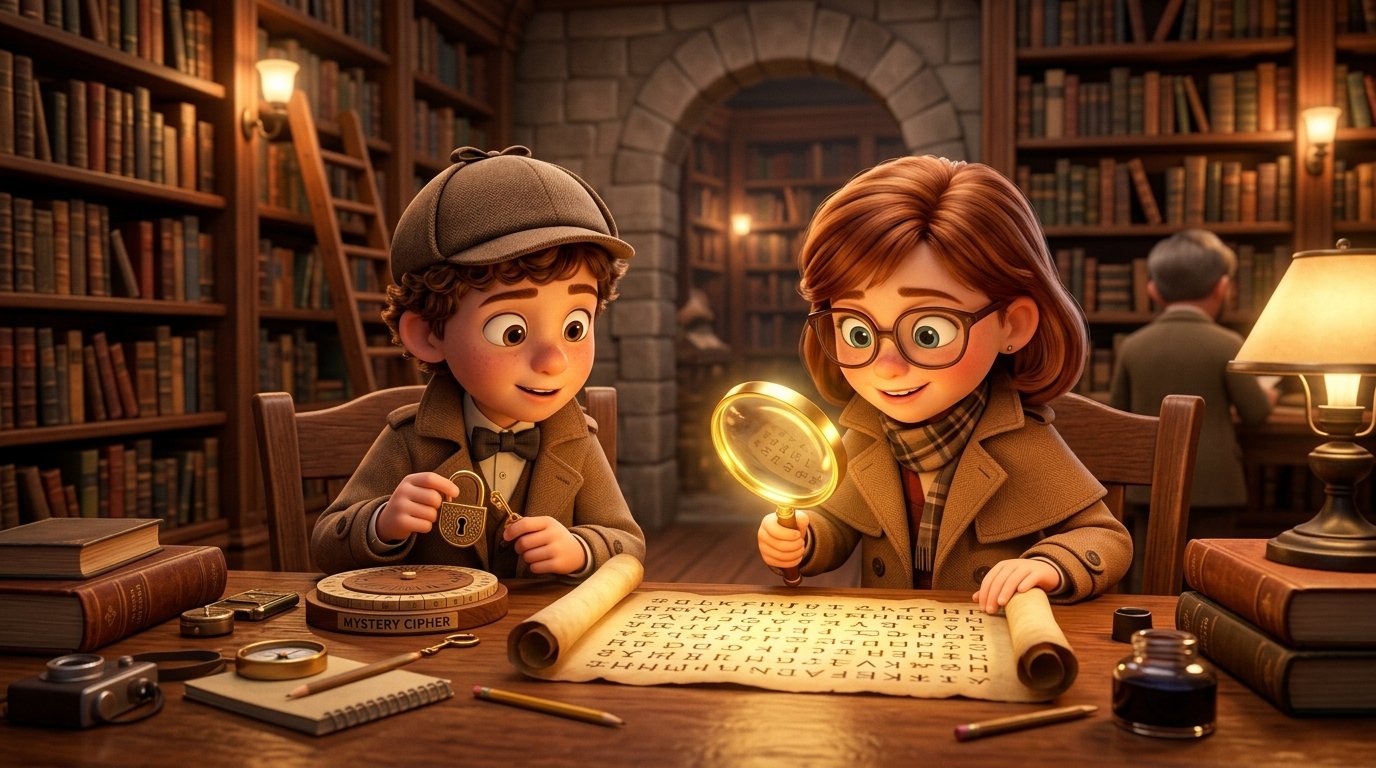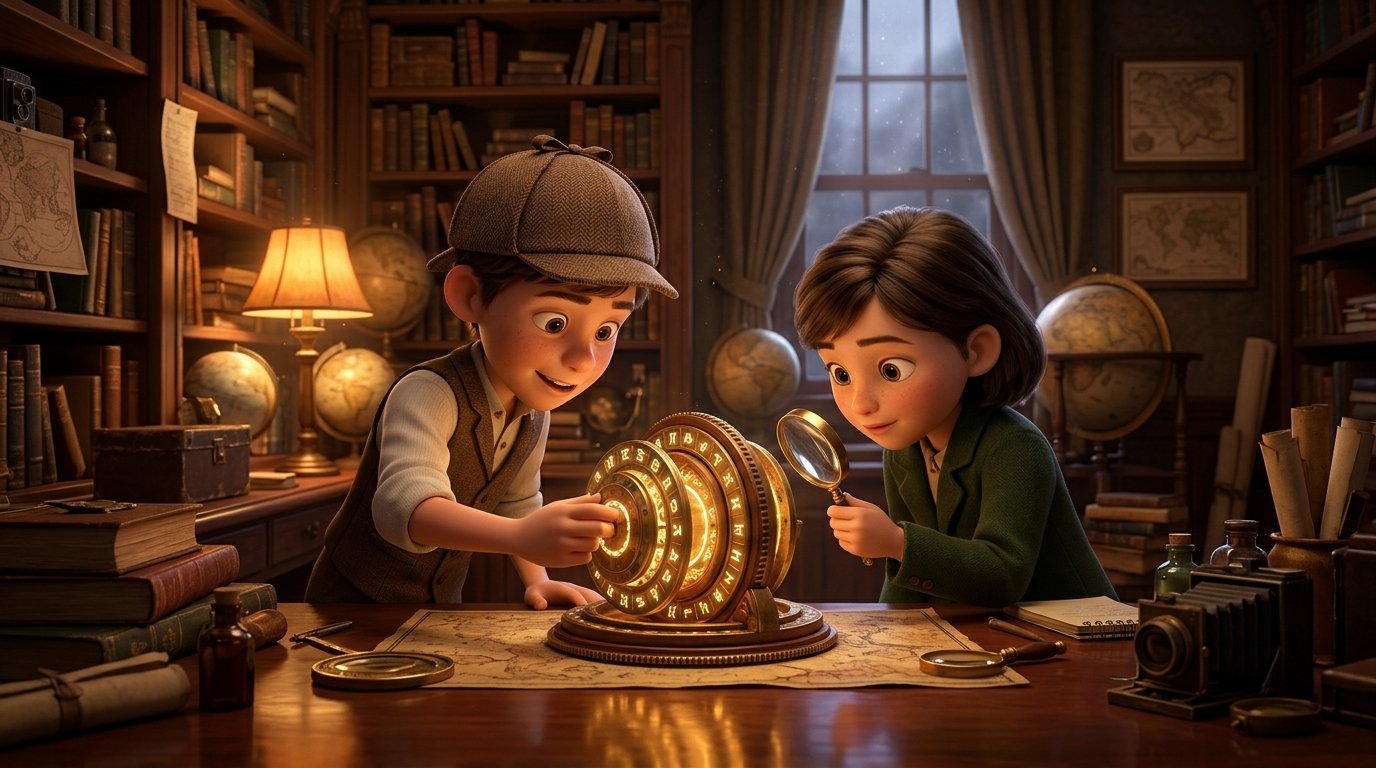
The Timeless Allure of Geometric Secret Codes
From the secret handshakes of childhood clubhouses to the clandestine correspondence of George Washington's Culper Spy Ring during the American Revolution, secret codes have always ignited the human imagination. While standard letter-for-letter substitution ciphers (cryptograms) are fantastic for developing frequency analysis, introducing geometric and reversal ciphers introduces an irresistible visual and spatial dimension to cryptology.
Two of the most historically rich and visually accessible ciphers for elementary and middle school students are the Pigpen Cipher (also known as the Masonic or Freemason's Cipher) and the ancient Atbash Cipher. In this guide, we break down how both ciphers work, their fascinating historical origins, and practical classroom activities that turn language arts into high-stakes espionage.
1. The Pigpen Cipher: Writing in Geometric Enclosures
Dating back hundreds of years and famously utilized by the Freemasons in the 18th century to keep their records private, the Pigpen Cipher replaces letters of the alphabet not with other letters, but with geometric fragments of a tic-tac-toe grid and an X-shaped cross.
How the Pigpen Key Works:
- Draw a standard 3x3 tic-tac-toe grid. Fill the nine spaces with letters A through I.
- Draw a second 3x3 grid, but add a central dot in each cell. Fill these spaces with letters J through R.
- Draw a large X-shape divided into four quadrants (top, bottom, left, right). Fill the quadrants with letters S, T, U, V.
- Draw a second X-shape with dots in each quadrant. Fill with letters W, X, Y, Z.
To encrypt a letter, you simply draw the enclosing lines (the "pigpen") that border that letter! For instance, the letter A looks like an open square corner (bottom and right lines), while the letter E is completely enclosed like a box. If the letter belongs to the second grid, you add a dot inside the shape. Because every symbol is a distinct geometric fragment, children perceive the cipher as an ancient alien language or magical rune set, making handwriting and decoding practice deeply thrilling.
2. The Atbash Cipher: Ancient Biblical Alphabet Inversion
Dating back to the Hebrew Bible and Jeremiah's scribes around 500 BCE, the Atbash Cipher is an elegant monoalphabetic substitution cipher based on symmetric reversal. In Atbash, the first letter of the alphabet maps to the last letter, the second maps to the second-to-last, and so forth:
Plain:  A B C D E F G H I J K L M N O P Q R S T U V W X Y Z
Cipher: Z Y X W V U T S R Q P O N M L K J I H G F E D C B A
What makes Atbash brilliant for young minds is its reciprocal symmetry: encrypting a word and decrypting a word use the exact same algorithm! If A becomes Z, then Z automatically becomes A. Students learn to spot letter complements: B pairs with Y, C pairs with X, and M pairs with N. It provides a tactile introduction to mathematical symmetry and mirror reflections across a linear number line.
3. Comparing Substitution Mechanisms
- Pigpen: Teaches spatial-geometric decoding, angle recognition, and visual-motor drawing precision. Zero vocabulary constraints; pure visual mapping.
- Atbash: Teaches linear indexing, alphabet positioning, and reciprocal mathematical functions.
- Random Cryptogram: Teaches linguistic frequency analysis, vowel-consonant clustering, and English grammar patterns.
"Secret codes don't just teach children how to hide messages; they teach them how language is structured, how patterns emerge from chaos, and how persistence unlocks any mystery."
4. Classroom Espionage Missions with PuzzleNest
Create a thrilling "Classroom Spy Academy" unit:
- The Scavenger Hunt Clue Chain: Hide three clues around the playground or library. Clue 1 is written in Pigpen, leading to a book containing an Atbash-encoded bookmark, which reveals a final locked box code created with our Cryptogram Maker.
- Secret Pen-Pal Exchange: Pair students across reading tables. Have each student encode a weekly science inquiry question in Atbash for their partner to solve before lunch.
Explore PuzzleNest’s suite of free decoding tools, including our Online Cryptogram Generator, to create instant classroom spy printables today!