Why Every Child Loves Becoming a Secret Agent: The Brain Science of Ciphers
Slip a regular spelling worksheet in front of an elementary or middle school student, and you may be met with an audible sigh. But hand that exact same student an envelope stamped with a bold red "TOP SECRET // CLASSIFIED" seal containing a mysterious encrypted message written in strange runes, and their posture transforms instantly. Eyes widen, focus sharpens, and the child leans forward—no longer a passive student completing an assignment, but an elite secret agent on a mission to save the world.
Cryptography—the ancient art and mathematical science of secret writing—is one of the most powerful pedagogical trojan horses available to educators. Beneath the playful allure of spy missions and escape rooms lies the foundational core of modern computational thinking: pattern recognition, algorithmic transformation, symbol substitution, and rigorous deductive logic. In this guide, we break down five easy-to-learn ciphers for kids, explain the science of frequency analysis, and share a blueprint for building a 30-minute classroom escape room.
1. The Caesar Shift: The World's Most Famous Cryptographic Algorithm
Named after Julius Caesar, who used it to communicate confidential military commands to his generals across the Roman Empire, the Caesar Cipher is the foundational stepping stone of cryptology:
- The Mechanics: Every letter in the plaintext message is shifted a fixed number of positions down the alphabet. For instance, in a ROT-3 (Rotate 3) shift:
A → D, B → E, C → F ... X → A, Y → B, Z → C - Encoding Example: The word MAZE shifted by +3 becomes PDCH.
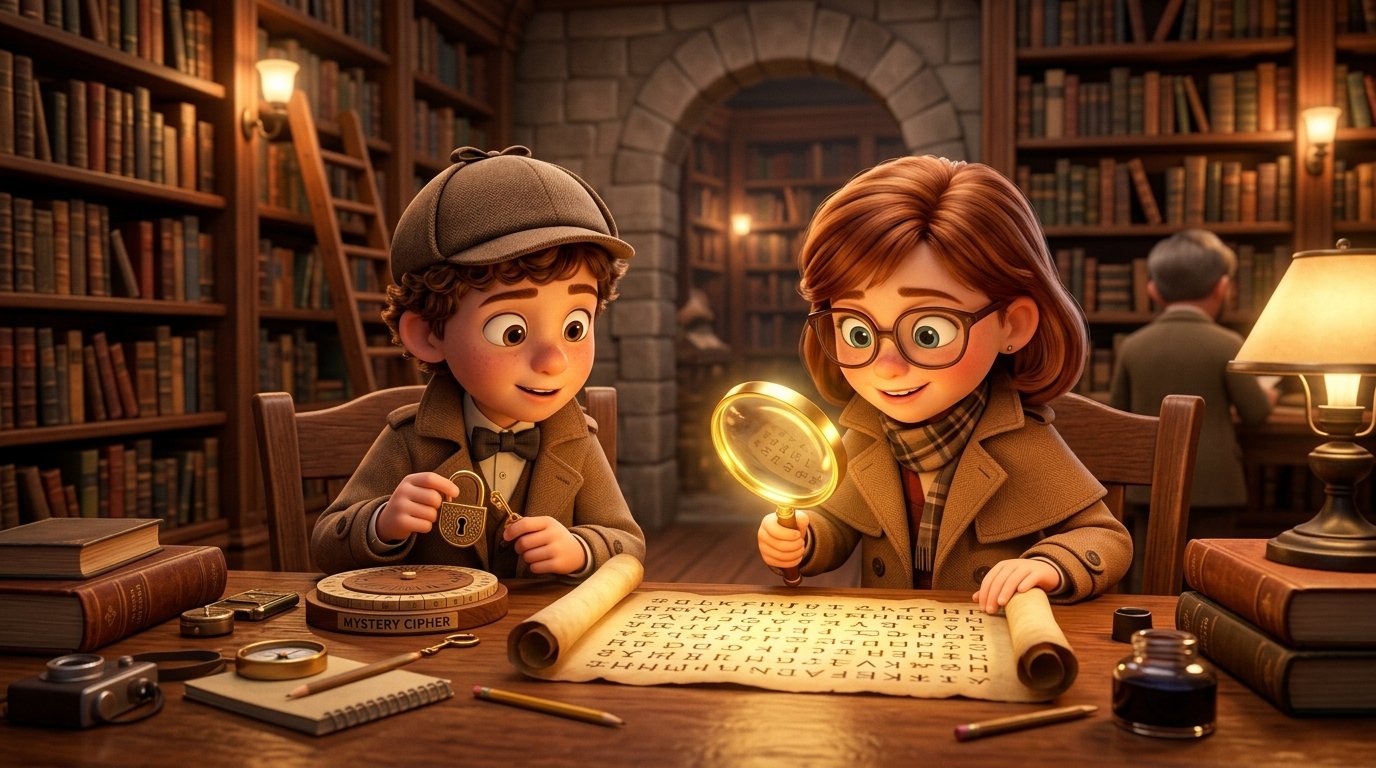
- Hands-On Cipher Wheels: You can print two concentric paper circles—a large outer wheel with the standard alphabet and a smaller inner wheel that rotates on a split-pin brass brad fastener. By turning the inner wheel three clicks, children can visually encode and decode secret messages without mental fatigue.
2. The Pigpen Cipher (Freemason's Cipher): Visual Geometric Substitution
Used widely by 18th-century Freemasons and Confederate soldiers during the American Civil War, the Pigpen Cipher replaces letters with whimsical geometric grid fragments:
- Draw two tic-tac-toe grids (#) and two large X shapes.
- Distribute the 26 letters of the alphabet across the grid spaces (two letters per cell, with the second letter denoted by a dot).
- To encode a letter, simply draw the surrounding grid lines and dot that enclose the letter. For instance, the letter 'A' is represented by a simple right-angle bracket (└).
Because the symbols look like alien glyphs or ancient secret runes, children find the Pigpen cipher irresistible. It provides fantastic spatial reasoning practice for visual learners.
3. Letter Frequency Analysis: How Detectives Crack Codes Without Keys
What happens when a secret agent discovers an encoded message, but does not know the cipher key? This is where cryptanalysis turns into real mathematics. In 9th-century Baghdad, the polymath philosopher Al-Kindi discovered that in any human language, letters do not appear with equal frequency:
"In the English language, the letter E is by far the most common, accounting for approximately 12.7% of all written letters, followed closely by T, A, O, I, N, S, H, R, D, L, U (the famous mnemonic phrase: ETAOIN SHRDLU)."
By creating a frequency table of the mystery symbols in a long encrypted paragraph, young detectives quickly identify that whichever symbol appears most frequently is almost certainly the letter 'E'. Single-letter standalone words must be either 'A' or 'I', and common three-letter combinations ending in 'E' are usually 'THE'. Teaching frequency analysis introduces students to real-world statistical distribution and probability in an unforgettable mystery context.
4. Spatial Direction & Coordinate Ciphers (N-S-E-W Mapping)
Connect cryptography directly to geography and spatial geometry using coordinate mapping codes:
- Grid Coordinate Ciphers: Construct a 5x5 grid containing the alphabet (combining I and J). Encode letters using row and column numbers (e.g., A = 11, B = 12, Z = 55).
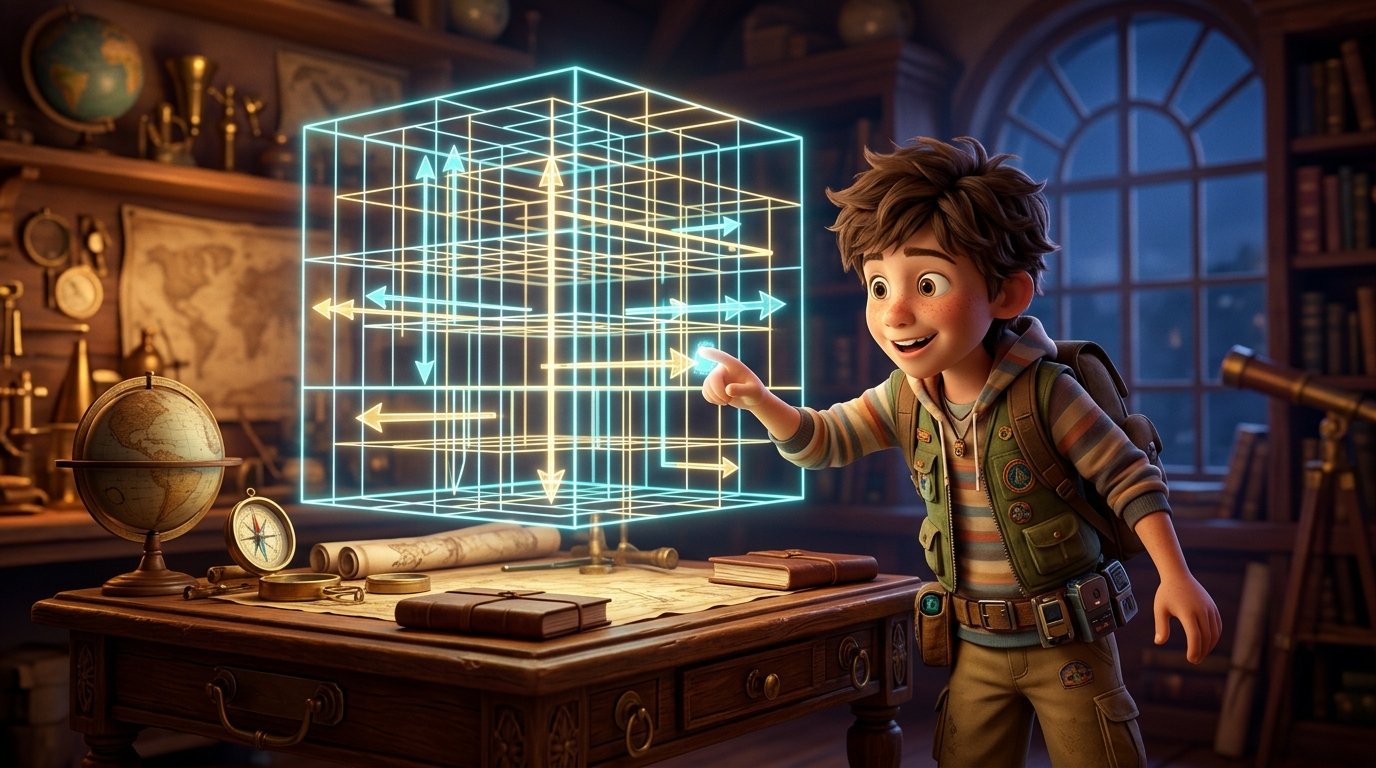
- Compass Direction Pathways: Provide a grid map where clues read: "Start at the oak tree: 3 steps North, 2 steps East, 1 step South (Collect letter: M)." Students trace the spatial cardinal directions on graph paper to spell out the secret password.
5. Building an Interactive 30-Minute Classroom Escape Room
Transform your classroom into an exhilarating mystery mission with this low-prep escape room blueprint:
- The Briefing (Minute 0–5): Announce that a rogue supervillain has locked the classroom treasure chest (filled with fun stickers or homework passes). Distribute agent badges and mission envelopes to collaborative teams of 3–4 students.
- Station 1 - The Pigpen Clue: Teams decipher a geometric Pigpen note taped beneath a desk to discover the location of a locked box.
- Station 2 - The Caesar Wheel Math Riddle: Decipher a ROT-5 message that reveals an arithmetic equation (e.g., "Multiply 7 by 8 and add 14"), yielding a 3-digit numerical lock code (070).
- Station 3 - The Crossword Coordinate Finale: Complete a custom vocabulary crossword puzzle where highlighted grid letters reveal the master password to unlock the final treasure!
Unleash the Power of Deductive Reasoning
Secret codes prove that logic, spelling, and mathematics are not dry chores—they are the secret keys that unlock thrilling mysteries.
Create custom vocabulary puzzles, arithmetic grids, and secret word challenges today with PuzzleNest's Free Crossword & Logic Puzzle Generators!