Breaking Free from the Flatlands: Why 3D Spatial Reasoning Matters
In Edwin A. Abbott's classic 1884 mathematical novella Flatland, two-dimensional beings living on a flat plane find it impossible to conceive of a third vertical dimension—unable to comprehend the concept of "Up" and "Down" beyond their surface world. While modern children live in a rich three-dimensional physical environment, an astonishing percentage of elementary and middle school spatial curriculum remains trapped entirely in 2D "Flatland": flat paper worksheets, flat coordinate grids, and flat maps.
Yet the modern world increasingly demands advanced three-dimensional spatial cognition. From robotics programming and aerospace navigation to 3D computer animation, video game physics engines, and architectural CAD design, future innovators must mentally rotate, navigate, and visualize multi-axis spatial systems. In this guide, we explore how 6-directional coordinate navigation puzzles (incorporating North, South, East, West, Up, and Down) develop high-level spatial acuity in students.
1. The Geometry of 6-Directional Cartesian Space $(x, y, z)$
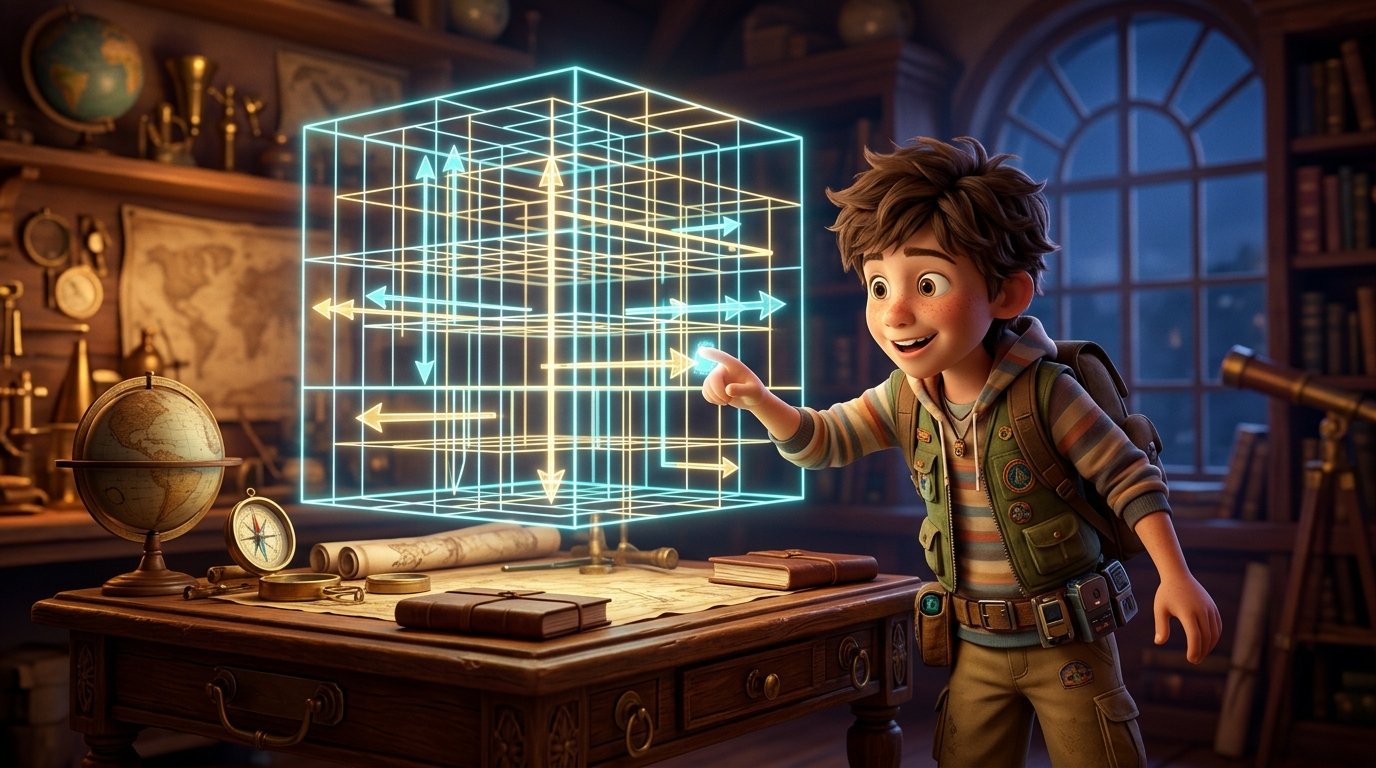
When students transition from standard 2D Cartesian coordinates $(x, y)$ to full 3D spatial navigation $(x, y, z)$, the cognitive challenge expands exponentially:
- Horizontal Axes ($X$ and $Y$): Mapped as traditional cardinal directions: North (+Y), South (-Y), East (+X), and West (-X).
- Vertical Axis ($Z$): Represents elevation and depth: Up (+Z) and Down (-Z).
In a 3D coordinate puzzle, navigation paths travel through multi-level cubic lattices (e.g., a $4 \times 4 \times 4$ voxel cube containing 64 spatial cells). Solvers must track not only which room they occupy on their current floor, but how elevators, ramps, ladders, and portals connect levels vertically!
2. Isometric Grid Mazes: Simulating 3D on 2D Paper
You don't need expensive virtual reality headsets to teach 3D navigation. Isometric grid paper (featuring triangular grids arranged at 60-degree angles) allows students to draw and solve 3D cubic labyrinths on standard printed sheets:
"Guiding a pencil along isometric lines—stepping 'East' across a cube surface, then climbing a vertical 'Up' ladder before traversing 'North' across an elevated walkway—trains the brain to mentally synthesize 3D depth cues from 2D optical stimuli."
Occupational therapists and neuroscientists have demonstrated that isometric spatial mapping activates both parietal lobes, dramatically boosting mental rotation speed and spatial memory bandwidth.
3. 3 Scaffolded 3D Spatial Mapping Challenges
Incorporate these progressive spatial navigation challenges into your STEM stations:
- The Subterranean Mine Shaft Mission: Students receive a 3D voxel map of an underground research facility across three stacked levels (Level 1 Surface, Level 2 Bunker, Level 3 Cave). Directional clues read: "Start at Entrance (1,1,1): Walk 3 steps East, climb 1 level Down, walk 2 steps North, climb 1 level Up. What room did you enter?"
- The Minecraft & Voxel Architecture Challenge: Have students construct a physical multi-level cubic maze using plastic building blocks or sugar cubes. Students record their path using formal 6-directional notation (e.g.,
[E3 → U1 → N2 → D1 → W1]), then challenge a classmate to replicate the exact route! - The Drone Pilot Flight Simulator: Project a 3D room coordinate system onto your classroom smartboard. Students act as drone navigators, issuing sequential 6-directional waypoint commands to steer an imaginary delivery drone past obstacles to a target landing pad.
4. Connecting Spatial Coordinates to Coding and Robotics
Teaching 6-directional navigation provides authentic preparation for block-based coding (Scratch) and text programming (Python). When students program a virtual turtle or robotic arm, every command relies on directional vectors. Understanding that a 3D coordinate is simply a composite vector of directional steps bridges elementary math to high school vector calculus and physics.
Elevate Spatial Thinking Beyond the Flat Page
Challenging children to navigate in three dimensions expands their visual imagination and proves that mathematics is an immersive landscape waiting to be explored.
Create custom coordinate grids, tessellation mats, and geometric worksheets today on PuzzleNest's Free Math Puzzle & Maze Tools!