Making Fractions Concrete: Moving Beyond Abstract Denominators
Ask any elementary school teacher to identify the exact topic where students first begin to lose their mathematical confidence, and the answer is almost universal: fractions. For years, children learn that 4 is greater than 2. Then, suddenly, they are told that $\frac{1}{4}$ is actually smaller than $\frac{1}{2}$. This fundamental violation of whole-number intuition causes thousands of students to fall into the trap of mechanical algorithm memorization without any genuine conceptual understanding.
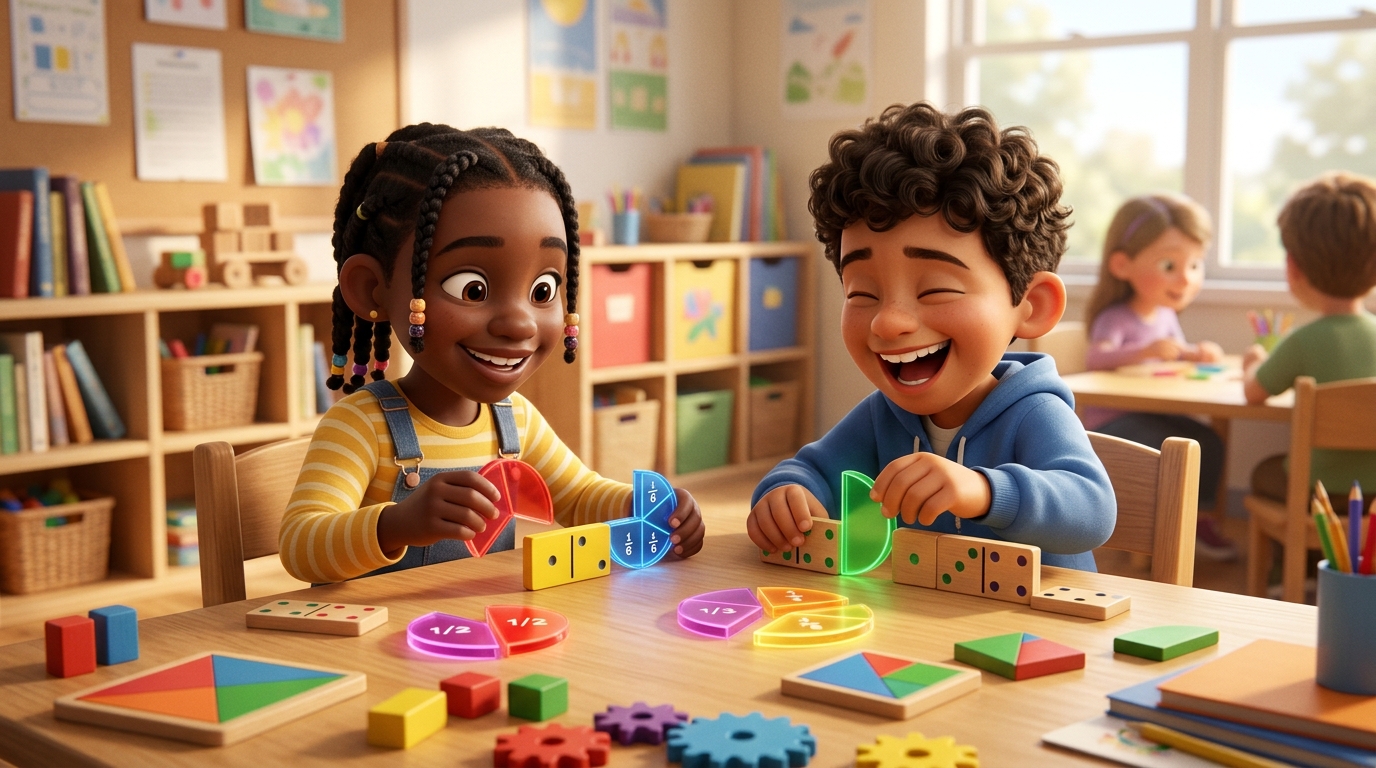
To master fractions, children need tactile, visual models that demonstrate proportional equivalence. Printable Fraction Equivalence Dominoes provide an irresistible, hands-on game framework. By matching numerical fractions directly to shaded circular pie wedges, tape diagrams, and rectangular grid models, children visually experience that $\frac{2}{4}$, $\frac{3}{6}$, and $\frac{4}{8}$ occupy the exact same physical space as $\frac{1}{2}$.
1. The Fallacy of the Common Denominator Drill
When fraction equivalence is taught purely through arithmetic procedures—such as multiplying the numerator and denominator by 2 or finding the lowest common multiple—students often perform the operations blindly. If asked whether $\frac{3}{5}$ or $\frac{4}{7}$ is larger, they reach for pencil and paper to cross-multiply rather than using spatial estimation.
Fraction domino puzzles rewire this intuition by pairing symbolic digits with dual visual representations on every tile. One half of the domino might show the numerical fraction $\frac{2}{6}$, while the other half displays a shaded rectangular area model representing $\frac{1}{3}$. To legally place a domino during gameplay, the student must prove equivalence between the numerical fraction and its visual counterpart, anchoring the concept of ratio invariance.
2. The Harmonic Family: Halves, Thirds, Fourths, and Sixths
Introducing too many unrelated denominators simultaneously triggers cognitive overload. High-retention fraction curricula focus first on the Harmonic Family of 12—denominators that share clean, intuitive geometric relationships:
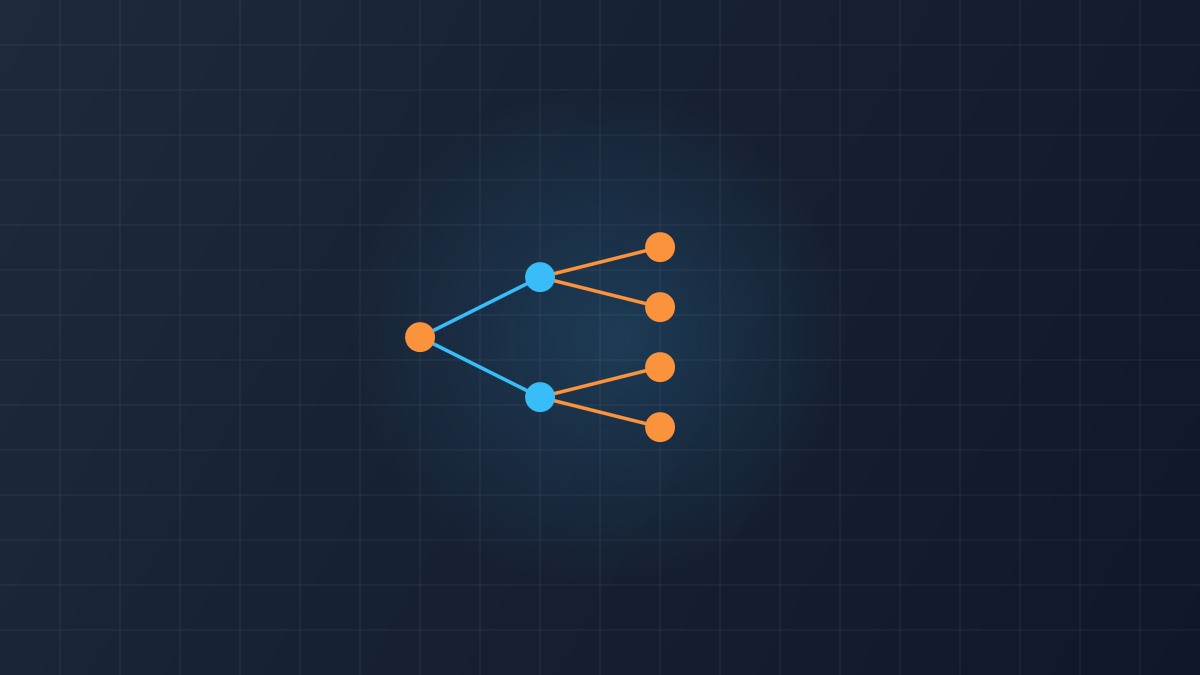
- The Halves and Fourths: Dividing a whole pizza in half, and then halving each half into fourths ($1 \rightarrow \frac{1}{2} \rightarrow \frac{1}{4} \rightarrow \frac{1}{8}$).
- The Thirds and Sixths: Dividing a clock face into 20-minute thirds, and then bisecting those into 10-minute sixths ($1 \rightarrow \frac{1}{3} \rightarrow \frac{1}{6} \rightarrow \frac{1}{12}$).
- The Grand Bridge: Discovering that $\frac{1}{2}$ is identical to $\frac{2}{4}$, $\frac{3}{6}$, and $\frac{6}{12}$ connects the two visual families into a unified proportional spectrum.
"A child who can visually see that two one-sixth slices fit perfectly inside a one-third boundary will never struggle to remember why common denominators are necessary for addition."
3. How to Play Fraction Equivalence Dominoes
Fraction dominoes adapt classic double-six domino rules for classroom stations or homeschool math games:
- Each player draws five printable domino tiles. A starter tile is placed in the center of the table.
- Players take turns matching an open end of the domino chain. A legal match requires pairing an equivalent numerical fraction with a shaded visual model (e.g., connecting the number $\frac{3}{4}$ to a pie chart with three out of four wedges shaded).
- If a player plays an equivalent pair with different denominators (e.g., matching $\frac{2}{4}$ to $\frac{1}{2}$), they earn a bonus point by vocalizing the proof: "Two fourths equals one half because both represent fifty percent of the whole."
- The first player to legally play all their dominoes wins the round.
4. Four Engaging Visual Fraction Lab Activities
- The Fraction Clothesline: Hang a length of string across the classroom labeled with 0 on the far left and 1 on the far right. Students use clothespins to pin fraction dominoes along the line, arguing why $\frac{3}{6}$ belongs at the exact midpoint and ordering non-equivalent fractions spatially.
- Lego Fraction Towers: Provide students with Lego bricks of varying lengths (8-stud, 4-stud, 2-stud, and 1-stud bricks). Students build vertical equivalent towers to physically verify common denominators.
- The Fraction Pizza Parlor: Students manage a simulated pizzeria where customer orders arrive in complex fractions (e.g., "I need a pizza that is $\frac{2}{6}$ mushrooms and $\frac{4}{8}$ pepperoni"), challenging students to simplify fractions to assemble the correct toppings.
- Fraction War Card Tournament: Players flip two fraction cards simultaneously. The player with the larger fraction wins the trick. Close ties are settled by overlaying transparent visual fraction circles.
Download our free printable Fraction Dominoes & Visual Math Worksheets on PuzzleNest to turn fraction dread into genuine mathematical joy today!