The Mind's Ability to Complete the Puzzle: What is Visual Closure?
Look at a billboard partially obscured by a tree branch, or read a text message on a smartphone whose screen has a single crack across the middle, and your brain effortlessly completes the picture. You do not need to see every single petal to identify a daisy, nor do you need to see all four tires to recognize a car. The human brain instantly fills in the missing gaps, constructing a coherent perceptual whole from incomplete visual fragments.
In cognitive neuroscience and pediatric occupational therapy, this critical visual-perceptual capacity is known as Visual Closure. It is one of the seven foundational pillars of visual processing, and it plays an indispensable role in how children learn to read fluently, write legibly, and organize mathematical information on a page.
1. The Direct Link Between Visual Closure and Reading Fluency
Novice readers inspect every letter with painstaking, laborious detail: analyzing every vertical stem, horizontal crossbar, and curved serif. But fluent adult readers do not read by inspecting entire letters; our eyes rapidly saccade across the page, identifying words in less than 200 milliseconds by scanning only the top half of the letter shapes!
If you cover the bottom half of a printed English sentence with a sheet of paper, a fluent reader can read it with nearly 100% accuracy. But if you cover the top half, reading speed drops by over 80%. This occurs because the top half of English lowercase letters contains the vast majority of distinctive features (ascenders like b, d, h, k, l, t and dot markers like i, j).
When a child suffers from underdeveloped visual closure skills:
- They read at a slow, agonizingly choppy pace because their brain cannot predict or complete word shapes rapidly.
- They confuse similar letters whose base structures overlap (like c and o, or h and n).
- They struggle to locate their place in a textbook or find items on a crowded classroom shelf because their visual system fails to recognize objects when partially covered.
2. Four High-Impact Therapeutic Puzzle Activities
Pediatric occupational therapists use these progressive printable challenges to rehabilitate and strengthen visual closure:
- The Half-Covered Word Window: Slide an index card horizontally across a list of sight words, leaving only the top 40% of the letters exposed. Challenge the child to read the words aloud at a brisk tempo, training their brain to rely on top-edge ascenders.
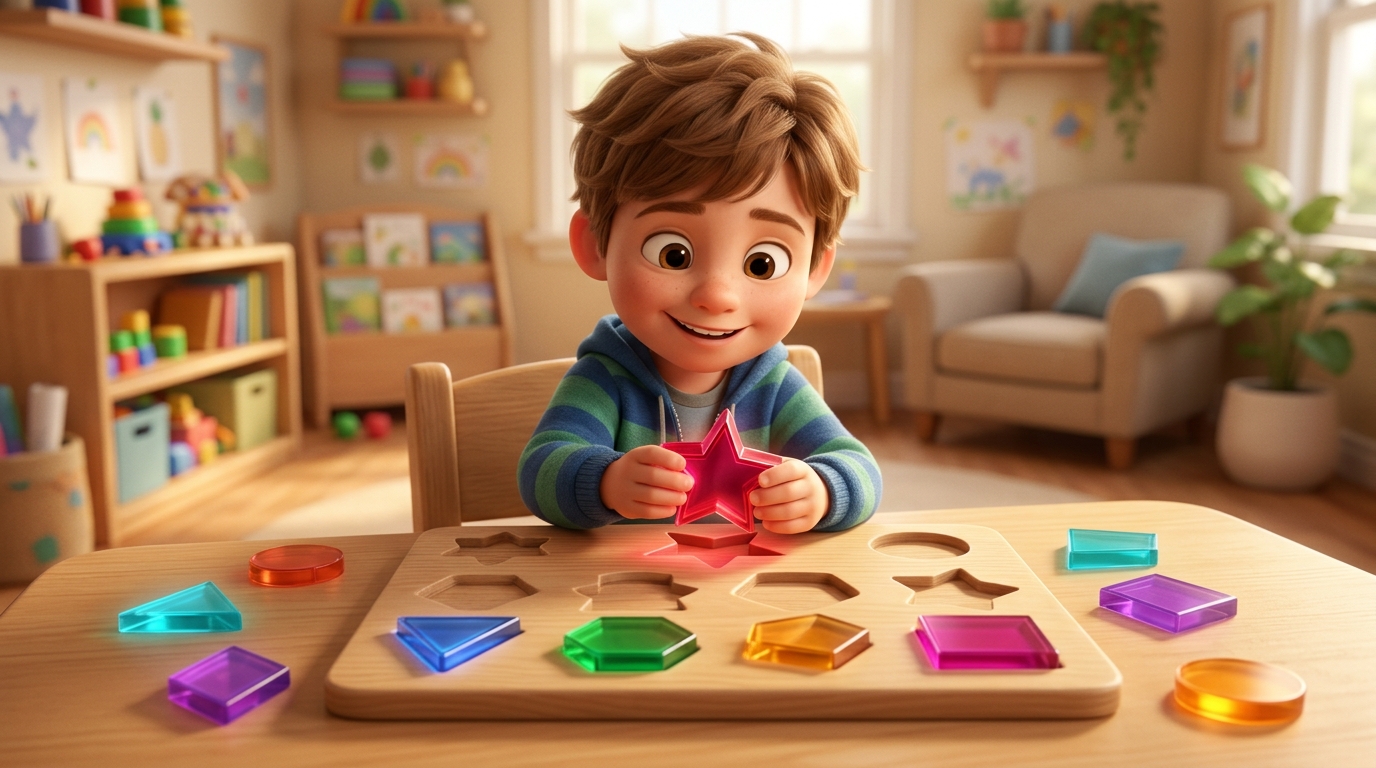
- Incomplete Shape Silhouettes: Display geometric shapes (stars, triangles, hexagons, crescent moons) where 30% of the perimeter line has been erased. The child must identify the shape and trace the missing segment to complete the figure.
- The Peek-a-Boo Animal Cutouts: An illustrated animal is hidden behind a wooden fence with only a tip of an ear, a striped tail, or a paw visible through the slats. Children deduce the animal based on distinctive textural clues.
- The Fragmented Letter Dot-to-Dot: Letters of the alphabet are drawn with dashed, broken strokes. Students must identify the letter before picking up their pencil to bridge the gaps.
3. Simple 5-Minute Classroom Warm-Up Drills
Integrate visual closure exercises into your daily morning meeting or literacy circle:
- The "Vanishing Sentence" on the Board: Write the morning message on the whiteboard. Erase the bottom third of all letters using an eraser swipe. Challenge the class to read the message in unison!
- Shadow Shape Matching: Present overlapping, semi-transparent silhouettes where two or three objects intersect. Students untangle the overlapping lines to name all hidden objects.
- Puzzle Piece Scavenger: Cut simple photographs of classroom tools into four irregular quadrants. Scatter three quadrants and challenge students to name the tool before finding the missing fourth piece.
Unlocking Effortless Visual Mastery
Visual closure transforms reading from an exhausting decoding struggle into an effortless, fluid dance. When children develop robust visual-perceptual closure, their reading comprehension surges because cognitive energy is no longer wasted on mechanical recognition. They are free to immerse their minds in the beauty, nuance, and joy of the stories they read.
Download free printable Visual Closure Worksheets, Fragmented Word Puzzles, and Occupational Therapy Perception Mats on PuzzleNest today!