Teaching Computer Science Without Staring at a Screen
In our hyper-digital era, many parents and educators assume that learning computer science requires putting children in front of glowing computer monitors to type syntax. Yet at its philosophical core, computer science is not about programming languages; it is about algorithmic thinking—the discipline of designing precise, step-by-step logical procedures to solve complex problems efficiently.
Some of the most profound concepts in computer science—such as algorithm complexity, Big O notation, and divide-and-conquer logic—are taught far more effectively through physical, tactile manipulatives. By using a standard deck of numbered playing cards or printable activity tokens, children can physically execute, compare, and understand world-changing sorting algorithms like Bubble Sort, Insertion Sort, and Merge Sort.
1. Why Sorting is the Backbone of Computing
Consider how often computers sort information: organizing millions of Google search results by relevance, ranking high scores in video games, or alphabetizing contacts on a smartphone. Computers cannot look at an entire disordered list at once the way a human eye does; a computer processor can only compare two individual values at a time.
When students physically step into the role of a computer processor—comparing only two playing cards in their hands at any given instant—they immediately understand why computer scientists have spent decades developing faster, more efficient sorting routines.
2. Bubble Sort: The Step-by-Step Neighbor Swap
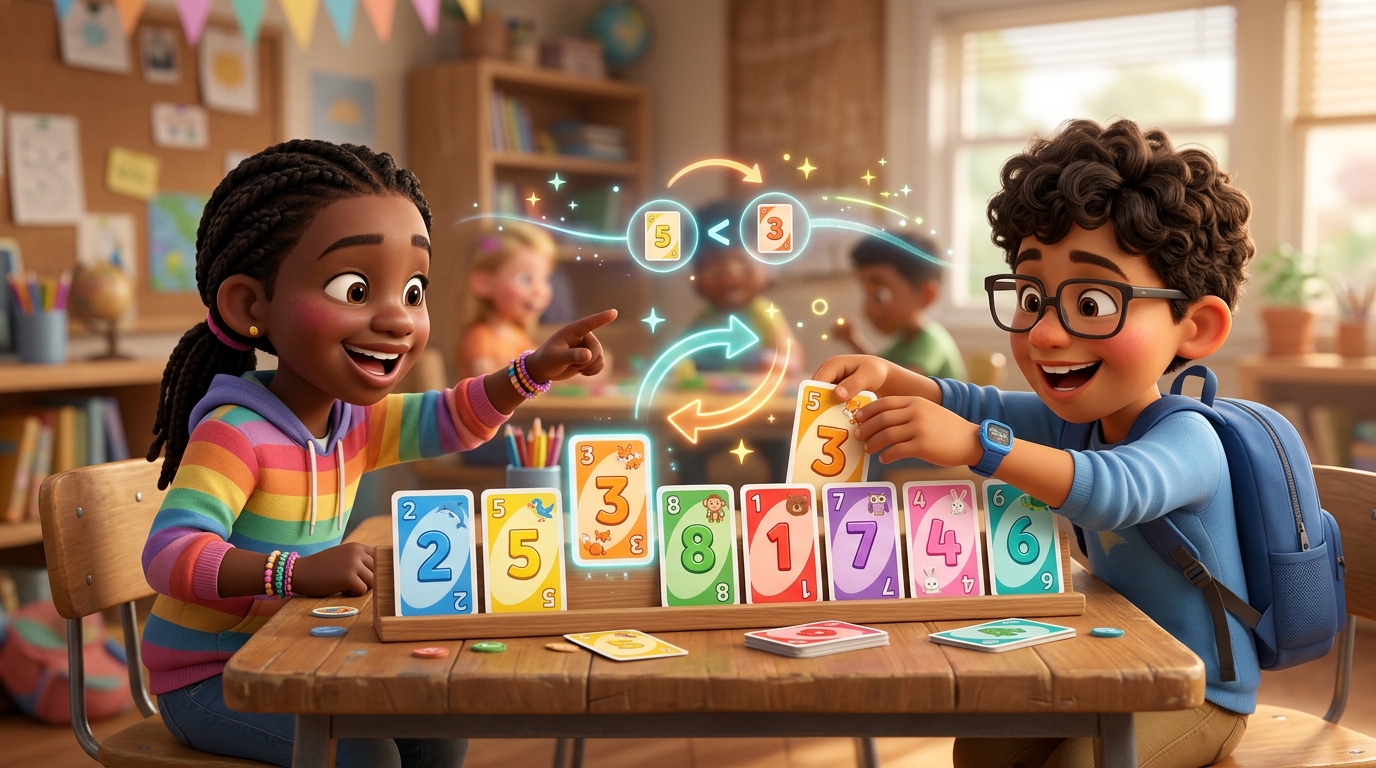
Bubble Sort is the most intuitive algorithm for young learners. Lay out five random numbered playing cards face-up in a row (e.g., 7, 2, 9, 1, 5). Give the student one simple programmatic rule: "Look at the first two cards. If the left card is bigger than the right card, swap them. Then slide one spot to the right and repeat until you reach the end."
During the first pass, students watch the largest number (the 9) gradually "bubble up" to the far right position like an air bubble rising through water. By tallying the total number of swaps and comparisons required to sort the cards, students discover that Bubble Sort requires a lot of repetitive work—an intuitive on-ramp to quadratic time complexity ($O(n^2)$).
3. Merge Sort: The Power of Divide and Conquer
Once students experience the repetitive nature of Bubble Sort, introduce them to the mathematical elegance of Merge Sort. Merge Sort operates on the legendary principle of divide and conquer:
- The Divide Phase: Split the row of 8 cards in half into two groups of 4. Split those into groups of 2, and finally into single individual cards. A single card by itself is, by definition, already sorted!
- The Conquer & Merge Phase: Compare two single cards and merge them into a sorted pair. Then compare the front cards of two sorted pairs to merge them into a sorted group of 4. Finally, merge the two sorted groups of 4 into a perfectly sorted deck of 8.
Students immediately observe that Merge Sort requires far fewer comparisons than Bubble Sort, providing an unforgettable physical demonstration of logarithmic algorithmic efficiency ($O(n log n)$).
"When children physically swap playing cards on a table, abstract algorithmic time complexity transforms from intimidating algebra into concrete, tactical realization."
4. Four High-Energy Unplugged CS Classroom Tournaments
- The Human Sorting Network: Draw a sorting network grid on the playground or gym floor with chalk. Six students stand on input squares holding numbered cards and walk along crisscrossing lines, pausing at designated junction boxes to compare numbers and swap lanes until they emerge in perfect numerical order.
- Algorithm Efficiency Stopwatch Duel: Pair students up. One student sorts 8 cards using Bubble Sort while the other uses Merge Sort. A referee counts the total number of physical card comparisons to see which algorithm finishes with fewer steps.
- Weighted Balance Scale Sorting: Use a mechanical balance scale and identical sealed canisters filled with varying weights of sand. Students must sort the canisters from lightest to heaviest using only two-at-a-time scale comparisons.
- Binary Search Guessing Quest: Lay out 16 sorted cards face-down. Challenge students to locate a secret target number in fewer than 5 flips by always flipping the exact middle card to eliminate half the deck (Binary Search).
Explore our free printable Unplugged Coding & Logic Worksheets on PuzzleNest to turn your classroom or living room into a hands-on computer science lab today!