The Intersection of Mathematics, Art, and Sacred Geometry
Walk through the Alhambra palace in Granada or the grand mosques of Isfahan, and you will witness one of the pinnacle achievements in human mathematical history: Islamic geometric tessellations. Centuries before Western mathematicians formalized crystallography, group theory, and periodic tiling in the late 19th and 20th centuries, medieval Islamic artisans were already designing intricate quasi-periodic tiling patterns with astonishing precision.
For middle school students who view textbook geometry as a dry collection of angle proofs and formula memorization, exploring Islamic geometric patterns offers a vibrant cross-curricular gateway. By constructing and coloring these breathtaking polygonal tessellations, students directly manipulate reflectional symmetry, rotational angle matrices, and plane-filling transformations.
1. The Secret of Girih Tiles: Modular Geometric Dissection
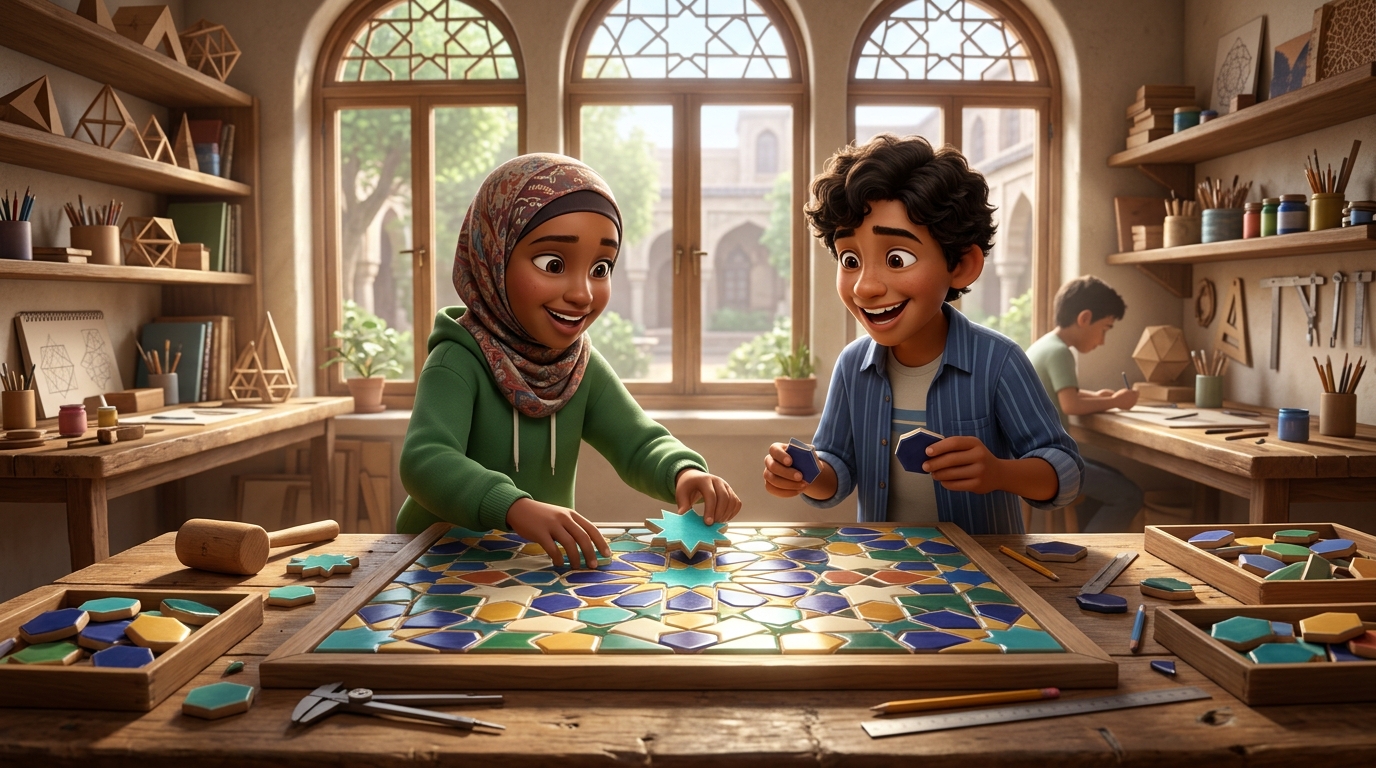
In 2007, physicists Peter Lu and Paul Steinhardt made an extraordinary discovery: medieval Islamic architects did not draft complex star-and-polygon mosaics solely with straightedges and compasses from scratch. Instead, they utilized a set of five standardized geometric puzzle tiles known as Girih tiles:
- The Regular Decagon: A ten-sided polygon with ten interior angles of 144 degrees.
- The Elongated Hexagon: An equilateral six-sided tile with interior angles of 72, 144, and 144 degrees.
- The Bow-Tie (Hexagram): A non-convex polygon with interior angles of 72 and 216 degrees.
- The Rhombus: An equilateral quadrilateral with angles of 72 and 108 degrees.
- The Regular Pentagon: A five-sided tile with interior angles of 108 degrees.
Each tile is decorated with specific strapwork lines. When students piece these modular tiles together on a puzzle worksheet, the decorative lines automatically align to create flawless interlocking star-and-weave patterns across the plane.
2. Rotational Symmetry and Plane Tiling Rules
A central concept in middle school geometry standards is understanding rigid plane transformations. Islamic tessellations provide spectacular concrete demonstrations of both n-fold rotational symmetry and dihedral reflection symmetry.
When students analyze an 8-pointed star rosette (Khatam), they calculate that rotating the figure by exactly 45 degrees leaves the pattern visually unchanged ($360^circ / 8 = 45^circ$). By examining how stars, hexagons, and rhombuses tile together without gaps or overlaps, students empirically prove that the sum of interior angles meeting at every vertex must equal exactly 360 degrees.
"Islamic geometric art demonstrates that the laws of spatial mathematics are not cold abstractions; they are the architectural grammar of breathtaking harmony and beauty."
3. Hands-On Compass and Straightedge Geometry Labs
Modern classrooms frequently neglect manual geometric drafting in favor of digital simulations. However, physically operating a compass and straightedge builds essential fine motor control, spatial foresight, and angle estimation. In a tessellation lab, students start with a single circle and use the radius step-off method to construct:
- A regular hexagon inscribed within a circle.
- A 12-pointed star constructed by overlaying four equilateral triangles rotated by 30 degrees.
- A self-repeating rosette border that tiles seamlessly across a full sheet of paper.
The tactile experience of swinging a compass arc, finding precise intersecting points, and watching complex crystalline geometry emerge directly from a simple circle is an unforgettable developmental milestone.
4. Four Engaging Tessellation Studio Projects
- Cardstock Girih Tile Mosaic: Print sets of the 5 Girih tiles on colored cardstock. Students cut them out and compete in teams to construct the largest periodic and non-periodic floor tessellations.
- Radial Watercolor Mandalas: Students draft a 6- or 8-fold radial rosette on watercolor paper, applying contrasting warm and cool watercolor washes to alternate symmetry rings.
- Stained-Glass Window Transparencies: Students outline geometric star polygons on clear acetate sheets with black dimensional paint, filling the faceted panes with colored permanent markers to mimic palace windows.
- Ethnomathematics Research Presentation: Students investigate the historical exchange of mathematical and astronomical knowledge along the historic Silk Road, connecting geometry to cultural exchange.
Explore our free Geometry & Pattern Activity Makers on PuzzleNest to generate printable polygon tiling sheets and spatial puzzles for your classroom!