Transforming Number Sense Through Visual-Spatial Pathways
Dyscalculia is a neurodevelopmental learning difference that affects a child's ability to acquire arithmetical skills, comprehend numerical magnitude, and manipulate abstract quantitative concepts. While standard classroom instruction relies heavily on symbolic equations and fast-paced mental arithmetic, the dyscalculic brain frequently struggles with the mental number line—the internal cognitive map that links digits like '7' to physical quantities.
When faced with a timed math worksheet, students with dyscalculia often experience severe mathematical anxiety, causing their working memory to freeze. Color-coded number line mazes provide a transformative, gentle alternative. By translating numerical relationships into tangible visual paths, labyrinths, and spatial journeys, these puzzles allow neurodiverse learners to experience mathematical magnitude somatically and visually without fear.
1. Rebuilding the Internal Mental Number Line
A neurotypical child effortlessly visualizes that 8 is closer to 10 than to 2. For a student with dyscalculia, however, numbers often appear as isolated, disconnected symbols with no intuitive sense of distance or relative value. This condition, often termed a deficit in subitizing and spatial magnitude estimation, makes basic addition feel like memorizing random strings of nonsense syllables.
Number line mazes address this directly by grounding numerals in physical distance. In a pathway maze, a child cannot simply skip from 2 to 9; they must physically trace along a structured sequence, observing that each step forward corresponds to a measurable advance in space. By embedding numbers within a continuous visual track, the abstract symbol is permanently linked to spatial length.
2. The Calming Architecture of Color-Coded Number Paths
Visual crowding and symbolic clutter represent major cognitive barriers for dyscalculic learners. Presenting dozens of black-and-white equations on a single sheet of paper induces visual stress. High-impact therapeutic number mazes employ intentional, research-backed color scaffolding:
- Even Numbers in Cool Tones: Evens are highlighted in calming blues and gentle teals, emphasizing stability and divisibility.
- Odd Numbers in Warm Tones: Odds appear in soft coral and warm peach, immediately signaling parity shifts.
- Milestone Multiples of 5 and 10: Landmark numbers are encircled with bright golden borders, serving as reassuring visual lighthouses along the maze route.
- Skip-Counting Color Waves: When practicing counting by 2s or 3s, consecutive steps share matching color gradients, allowing pattern recognition to guide the pencil before arithmetic doubt sets in.
"For a child with dyscalculia, a number is not just a digit; it is a location in space. Once they can see the path, they can navigate the math."
3. The CRA Sequence: Concrete to Representational to Abstract
Effective special education pedagogy relies on the Concrete-Representational-Abstract (CRA) instructional model. Number line mazes represent the crucial 'Representational' bridge:
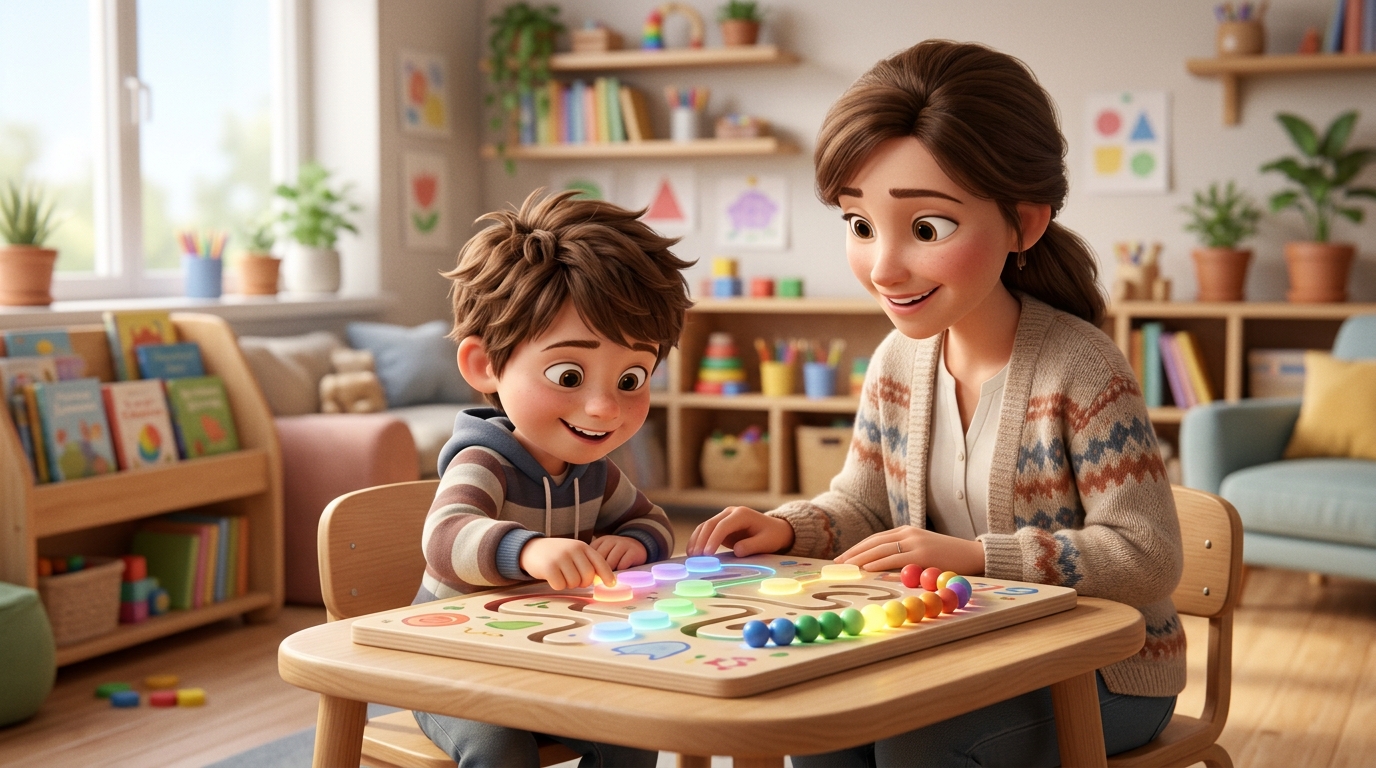
- Concrete Phase: The child begins by placing physical colored beads, counting cubes, or miniature toy figures on a large printed floor maze or desktop track.
- Representational Phase: The child traces their pencil through printed 2D number line mazes on paper, connecting numbered stepping stones to reach a goal.
- Abstract Phase: Having internalized the spatial distance traveled, the child transfers this intuitive understanding to formal arithmetic equations with genuine confidence.
4. Practical Classroom Accommodations for Dyscalculic Learners
- Generous Spatial Margins: Always print number mazes with enlarged fonts (minimum 18pt) and wide pathway corridors to eliminate visual overcrowding.
- Tactile Tracing Alternatives: Allow students to trace paths using scented markers, dry-erase styluses, or tactile wikki-stix rather than standard graphite pencils.
- Zero-Clock Policy: Never attach timers or speed drills to number maze activities. Emphasize exploratory accuracy, spatial reasoning, and curiosity.
- Self-Correcting Checkpoints: Include gentle pictorial checkpoints along the maze path (e.g., a friendly star at number 10, a compass at 20) so the child can independently verify their progress without teacher intervention.
Support your neurodiverse learners with gentle, stress-free printable math puzzles using PuzzleNest's free Math & Number Maze Builders today!