The Visual Perception Skills Behind Reading
When adults look at printed text, our brains identify letters and words instantly and effortlessly. But for a three- or four-year-old child, the alphabet is a dizzying landscape of subtle visual differences. What is the difference between a lowercase 'b', 'd', 'p', and 'q'? Each consists of a single vertical stick and a circle—the only difference is their spatial orientation.
Before a child can master letter recognition without confusion, their visual system must achieve a core perceptual milestone known as Form Constancy. In early childhood education and pediatric occupational therapy, Shadow and Silhouette Matching Worksheets are the primary tool used to nurture this foundational ability.
1. What is Form Constancy and Visual Closure?
Form Constancy is the brain's ability to recognize an object or shape even when its color, texture, size, or orientation changes. When a toddler looks at an apple, they recognize it whether it is green, red, sliced, or depicted as a solid black silhouette.
When color and internal details are stripped away, the child's brain cannot rely on superficial cues. They must examine the external contour geometry: the stem, the curved indent, the leaf. This exact perceptual skill is what enables a child to recognize that the letter 'A' is still an 'A' whether printed in bold Helvetica, cursive script, or chalk on a blackboard.
2. Preventing Early Letter Reversals and Confusion
Children who struggle with silhouette matching often experience persistent letter reversals (confusing b and d, or m and w). By providing regular practice pairing colorful real-world items (animals, vehicles, school tools) with their shadows, children develop sharp visual discrimination, noticing micro-differences in perimeter angles, tails, ears, and wheels.
3. Crossing the Midline and Bilateral Integration
A classic shadow matching worksheet displays colorful items on the left side of the paper and scrambled silhouettes on the right side. To complete the activity, the child must draw a continuous pencil line from the left column across to the right column.
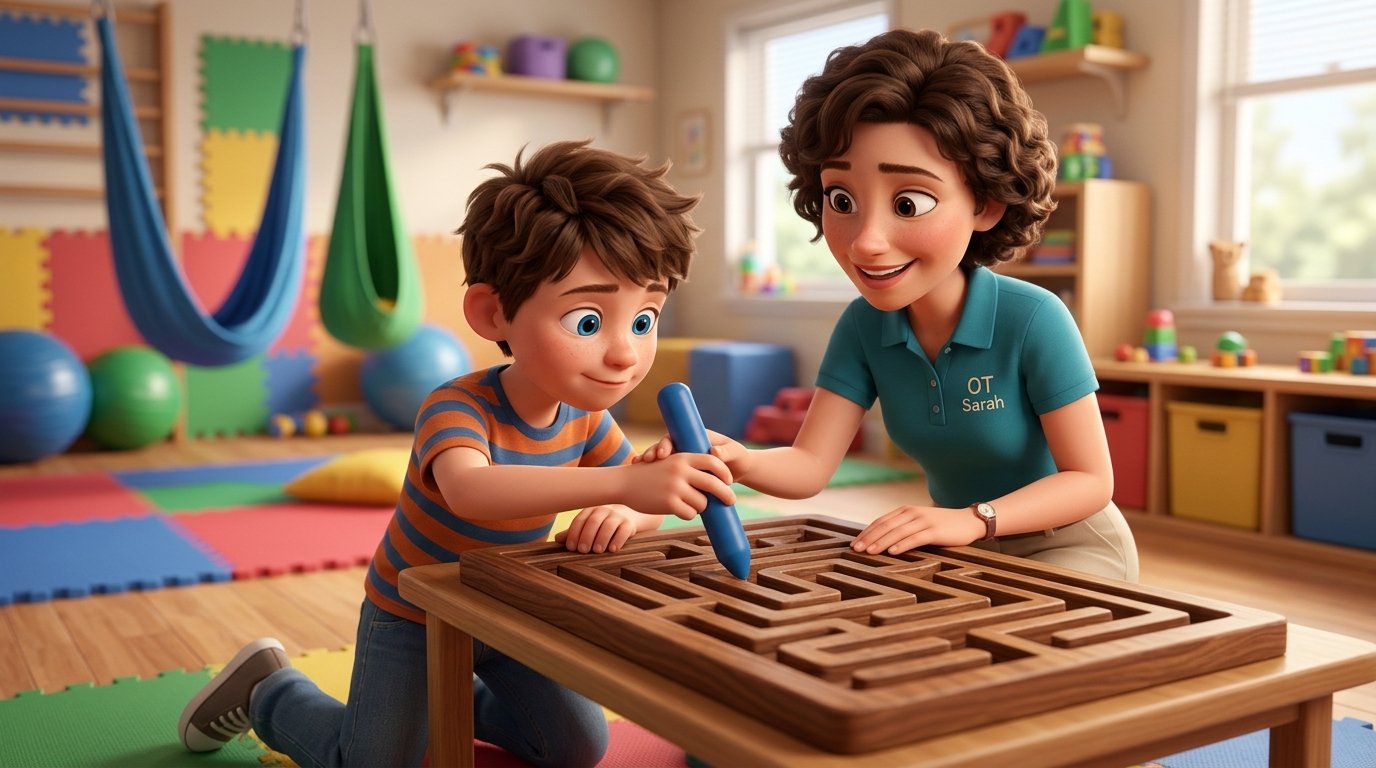
In occupational therapy, this action is known as Crossing the Midline. Reaching across the center of the body requires both cerebral hemispheres to communicate across the corpus callosum. Bilateral integration is essential not only for writing across a full notebook page from left to right, but also for tracking lines of text while reading without skipping sentences.
4. Classroom & Therapy Recommendations
- Calibrate Pair Counts: For toddlers and early intervention Pre-K, begin with 4 pairs. Scale up to 5 or 6 pairs for kindergarten readiness.
- Use High-Contrast Vector Silhouettes: Ensure silhouettes are crisp and distinct, displaying recognizable perimeter contours (such as the distinct propeller and wings of an airplane, or the ears of a rabbit).
- Physical Midline Tracing: Have children trace their finger along the line path before drawing with a crayon, building sensory-motor coordination.
"Visual perception is the invisible bedrock of literacy. Before a child learns to read words, they must learn to read shapes."
Create clean, printable Pre-K and OT worksheets with PuzzleNest's free Shadow Matching Generator—select themes, shuffle pairs, and export answer keys in PDF format with one click!