The Delightful Absurdity of the English Language
English is notorious for its eccentric orthographic quirks. A bare bear can eat a pear while wearing a pair of shoes. You can wind a watch while walking into a gust of wind. You can tear a piece of paper, shed a tear of sorrow, or paddle a rowboat in a row of houses. For third and fourth-grade students transitioning from phonetic phonics into advanced orthographic spelling, these linguistic paradoxes frequently trigger immense confusion.
Why do words that sound identical look completely different? And why do words that look identical sound completely different? The secret to demystifying these tricky words is not boring rote drills; it is leaning directly into the playful humor of visual pun puzzles and illustrated riddles.
1. The Neuroscience of Visual-Phonetic Disambiguation
To become a fluent reader, the brain must establish robust orthographic mapping—the neural process of binding a word's pronunciation (phonology), visual spelling (orthography), and contextual meaning (semantics) into an integrated neural circuit.
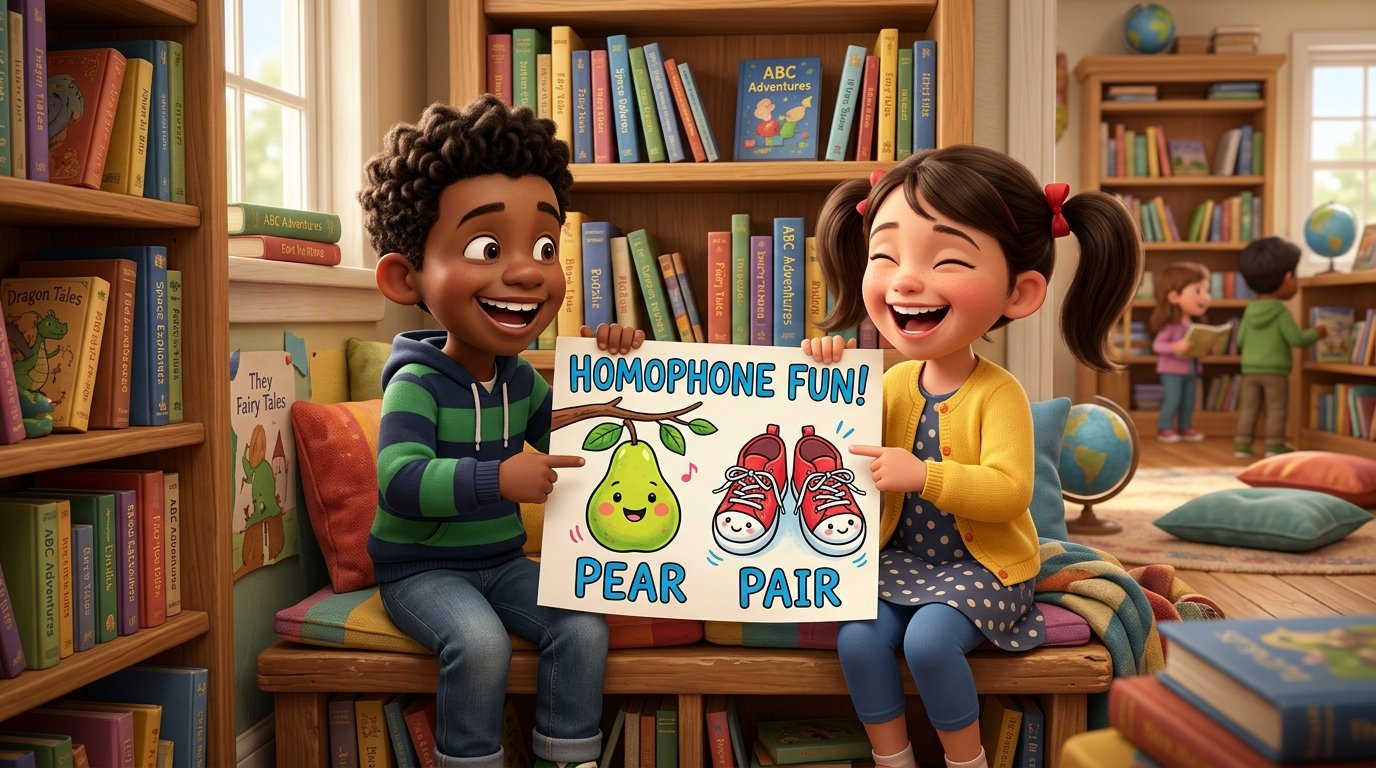
Consider the classic homophone pair: PEAR (the fruit) versus PAIR (a duo). If a child only hears the word spoken aloud, their auditory system activates a single phonetic representation: /pɛər/. By presenting an illustrated visual pun—such as a cartoon pear wearing a pair of sneakers—the child's brain is forced to resolve the semantic dissonance. The absurdity of the image acts as a powerful cognitive anchor, permanently locking the distinct spellings to their proper definitions.
2. Three Engaging Visual Pun Formats
Engage elementary readers with these scaffolded illustrated puzzle formats:
- Literal Idiom Cartoons: Show an illustration of a baker literally rolling in cash ("Rolling in dough") or a boy crying over a shattered glass of milk ("Crying over spilled milk"). Students identify the underlying idiom, write its actual figurative meaning, and solve a crossword clue anchored to the phrase.
- The Homophone Dual-Photo Riddle: Two side-by-side illustrated clue panels: Panel A shows a knight in shining armor galloping on a horse; Panel B shows a moonlit sky filled with stars. The clue reads: "One rides into battle; the other brings sweet dreams. They sound the same, but spell them both! [KNIGHT / NIGHT]".
- Homograph Context Clue Decoders: A single word must complete two completely different sentences with different pronunciations: "The archer shot an arrow with his wooden ________." and "The actors stepped onto the stage and took a deep ________." [BOW]. Students label the part of speech and practice pronunciation.
3. Hosting a Classroom Pun Championship
Encourage creative language play with these collaborative literacy games:
- The Illustrated Homophone Gallery Walk: Have students create their own illustrated homophone pun posters (e.g., "The witch who didn't know WHICH broom to buy"). Hang them around the classroom and have peers vote on the funniest and most clever creations.
- Homophone Dominoes: Create matching domino cards where one half has a definition and the other half has an illustrated pun. Students must connect matching homophone pairs end-to-end across a table.
- The Tricky Homophone Crossword Race: Weekly 10-word crosswords populated exclusively with standardized-testing demons (their/there/they're, its/it's, whether/weather, principal/principle).
Unlocking Linguistic Confidence
When students realize that word ambiguities can be sources of laughter rather than anxiety, their relationship with reading and writing fundamentally changes. They approach new vocabulary not with dread, but with the playful curiosity of a detective solving word mysteries.
Generate custom printable Homophone Crosswords & Phonics Word Search Worksheets on PuzzleNest today!