Transforming Rote Review into High-Energy Classroom Celebrations
Ask any group of middle school or high school students how they feel about end-of-unit review days, and you are likely to hear sighs of boredom. Traditional review strategies—such as teacher-led Q&A lectures or filling out repetitive study guides—place the cognitive load on a tiny handful of eager hand-raisers while the majority of students slip into passive daydreaming.
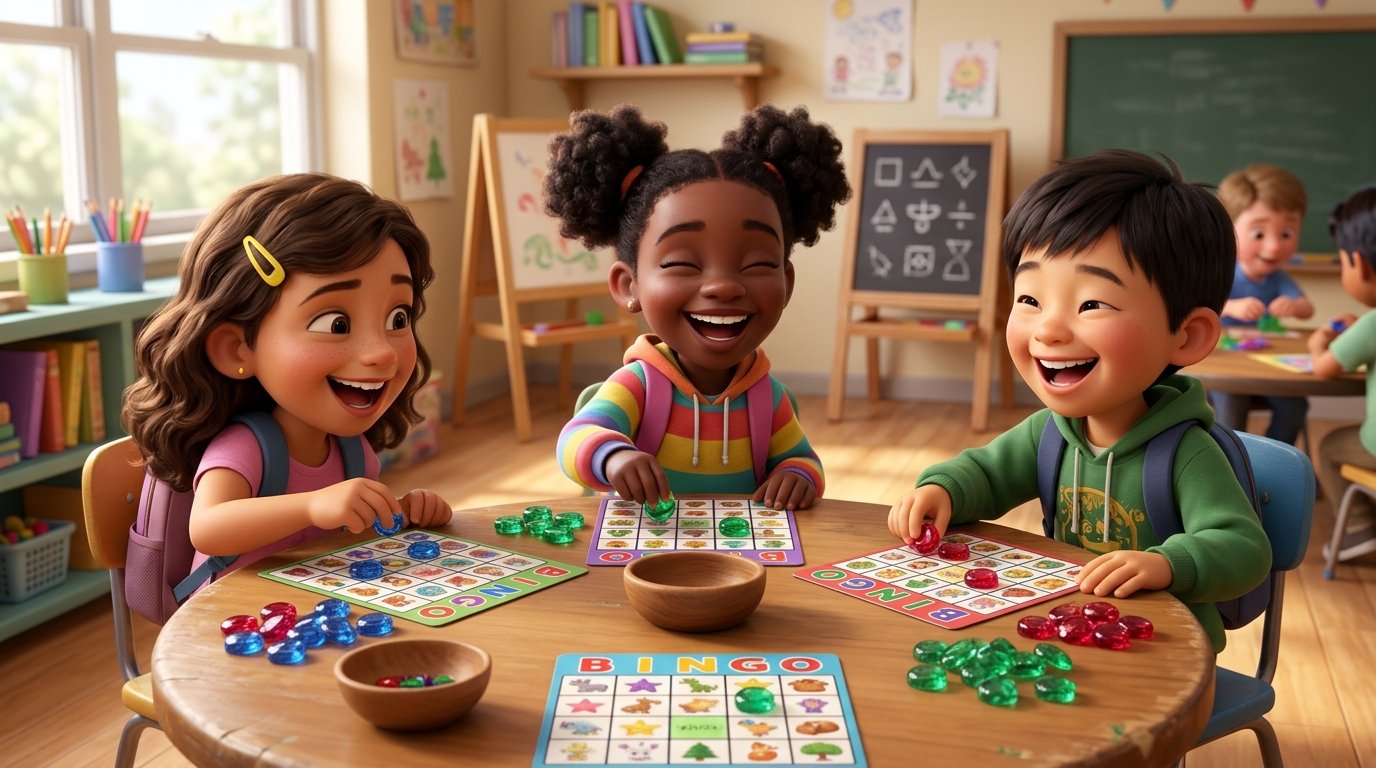
When teachers replace passive worksheets with a custom word bingo card generator, classroom dynamics invert instantly. Because every single student holds a uniquely randomized card, every learner is held 100% accountable for every single question. In this guide, we explore the cognitive science of active retrieval practice, detail how to adapt custom bingo across diverse academic disciplines, and share proven classroom management hacks for seamless game sessions.
1. The Cognitive Science: Active Retrieval vs. Passive Recognition
The pedagogical brilliance of educational word bingo lies in how clues are called. In casual gambling bingo, callers announce letters and numbers (like "B-12")—a mindless matching task. In educational bingo, however, the teacher calls out the definition, historical event, or mathematical equation, and students must actively deduce the vocabulary word before scanning their cards:
- Traditional Rote: Teacher: "What is the capital of Spain?" One student shouts "Madrid!" 29 other students passively write it down without cognitive effort.
- Educational Bingo: Teacher calls: "The capital and largest city of Spain located on the Manzanares River." Every student in the room must instantly query their semantic memory, retrieve the term MADRID, and scan their randomized 5x5 grid.
This dynamic triggers what cognitive scientists call the Testing Effect—forcing neural pathways to retrieve information under light, playful pressure, which produces significantly higher long-term memory retention than passive re-reading.
2. Cross-Curricular Game Blueprints
Deploy custom word bingo across every major academic subject:
- World History & Civics: Populate squares with historical figures, landmark treaties, and constitutional amendments (e.g., Magna Carta, 13th Amendment, Waterloo, Renaissance). The teacher reads primary source quotes or event descriptions as clues.
- Spanish & Foreign Languages: Write target vocabulary in English on the board, or say the foreign term aloud. Students mark the corresponding translation on their cards, cultivating rapid cross-linguistic listening fluency.
- Literature & Novel Studies: Review character archetypes, literary motifs, and figurative devices (metaphor, foreshadowing, tragic flaw, juxtaposition) before major book exams.
- Chemistry & Biology: Call chemical symbols (Fe, Au, Na) or biological cell organelles (mitochondria, ribosome, chloroplast) using their functional roles as clues.
3. The Mathematics of Randomization: Why Every Card Must Be Unique
Nothing ruins a classroom bingo game faster than three students sitting side-by-side shouting "BINGO!" on the identical clue because their cards share identical layouts. A true educational bingo generator utilizes Fisher-Yates scrambling algorithms to ensure that from a pool of 30 to 50 vocabulary words, every single printed card features a completely unique combination and spatial distribution of terms. This mathematical dispersion guarantees fair play and keeps tension soaring until the final winning call!
4. Dynamic Winning Formats to Keep Rounds Fast and Thrilling
Rotate through varied winning conditions to match your available lesson time:
- Four Corners (5-Minute Bell Ringer): Players mark only the extreme four outer corner squares. Fast, energetic, and ideal for starting class!
- Postage Stamp: Players must fill a 2x2 cluster of four squares in any designated quadrant.
- The Picture Frame: Cover every perimeter edge of the card, leaving the central interior empty.
- The Blackout Finale: Every square must be verified! The ultimate comprehensive review game for the final day before semester finals.
5. Classroom Management: Lamination and Reusable Counters
Save hours of photocopying by laminating class sets with 5-mil thermal laminating pouches. Students mark terms using dry-erase markers or colorful plastic counting chips. At the end of each round, a simple wipe with a dry cloth resets the boards for the next class period!
Design Custom Classroom Bingo in Seconds
Turn stressful test preparation into an unforgettable celebration of student knowledge and friendly collaborative competition.
Create, scramble, and print unlimited custom word and picture bingo cards today on PuzzleNest's Free Bingo Card Generator!