Turning Students into Historical Intelligence Agents
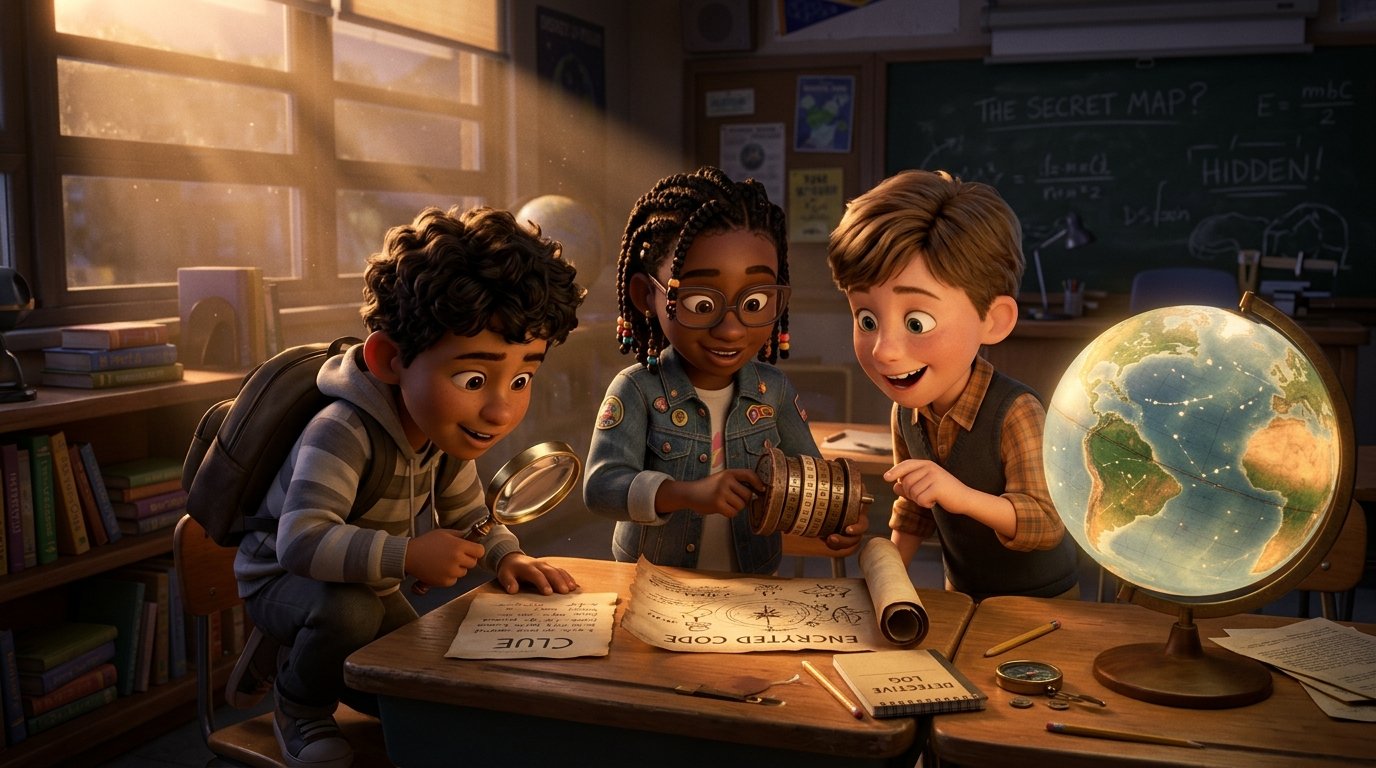
Few classroom activities ignite spontaneous, breathless engagement quite like an authentic codebreaking mystery. Hand a group of fourth or fifth graders a standard reading worksheet, and you may be met with collective groans; hand the exact same students an encrypted parchment sealed in an envelope stamped "CONFIDENTIAL: AGENTS EYES ONLY", and the room instantly crackles with focused, electric energy.
Cryptology—the mathematical science of encrypting and deciphering secret messages—is one of the most powerful interdisciplinary vehicles for modern educators. Blending historical narratives of Julius Caesar, Mary Queen of Scots, and the WWII Bletchley Park codebreakers with rigorous phonics decoding, frequency analysis, and modular arithmetic, an interactive Classroom Cipher Hunt transforms passive learners into unstoppable deductive detectives.
1. Three Accessible Historical Ciphers for Beginners
To ensure high participation across all academic skill levels, introduce students to three iconic cryptographic systems:
- The Caesar Shift Cipher (Modular Arithmetic): Used by Julius Caesar in 58 BCE to communicate with his battlefield generals. Every letter in the alphabet is shifted forward or backward by a secret fixed key ($K$). If $K = 3$, 'A' becomes 'D', 'B' becomes 'E', and 'Z' wraps around to 'C'. Students construct dual-ring cardboard cipher wheels to crack the shift.
- The Freemason's Pigpen Cipher (Spatial Geometry): A visual geometric substitution cipher popularized in the 18th century. Letters are placed inside hash-mark grids and diagonal 'X' frames. Instead of writing letters, agents draw the precise geometric angle and dot that enclose the letter.
- The Book Cipher (Coordinate Scanning): Agents receive three-number coordinates:
[Page, Line, Word]. To crack the message, students must locate the designated words inside an assigned classroom library novel or social studies textbook.
2. Step-by-Step Architecture of a 45-Minute Cipher Mission
Here is how to stage a flawless, low-stress classroom cipher hunt:
- The Dramatic Mission Briefing: The teacher dims the lights and reads an audio dispatch or sealed letter from Headquarters. A priceless school artifact (like the class mascot or science trophy) has been hidden by a villainous rogue professor.
- Division into Field Units: Divide students into balanced tactical squads of 3 to 4 detectives (incorporating assigned roles: Cryptographer, Scribe, Field Scout, and Evidence Keeper).
- Scattered Station Envelopes: Tape 5 coded envelopes at distinct coordinates around the room (behind the globe, beneath the periodic table, inside the supply closet). Cracking Cipher #1 reveals the physical riddle coordinates for Envelope #2.
- The Final Safe Combination: The final decoded parchment reveals a three-digit mathematical lock combination to a locked metal box containing the stolen artifact and victory stickers!
3. The Cognitive Dividends of Cryptographic Play
When children decode ciphers, their brains engage in sophisticated linguistic and mathematical processing:
- Letter Frequency Analysis: Students discover that 'E', 'T', 'A', and 'O' are the most common letters in English, while 'Q' and 'Z' are rarest, intuitively mastering statistical distribution.
- Phonemic Chunking: Recognizing that a single-letter word must almost certainly be 'A' or 'I', and that a common three-letter word ending in 'E' is likely 'THE'.
- Collaborative Resilience: When an initial decryption key produces gibberish, teammates learn to troubleshoot their shift offset without giving up.
Igniting Curiosity Through High-Stakes Storytelling
A great classroom cipher hunt leaves an indelible mark on young minds. Long after the mystery is solved, students remember the exhilaration of collaborative deduction and the profound realization that mathematics and language are the secret keys that unlock our world.
Generate printable Cipher Wheels, Pigpen Templates, and Secret Code Mission Packs on PuzzleNest today!