Beyond Rote Memorization: Experiencing the Geometry Behind the Equation
For generations of middle school students, the Pythagorean theorem has been introduced as a sterile algebraic mantra: "a squared plus b squared equals c squared." While students dutifully memorize the sequence of letters, an alarming percentage fail to grasp what the formula physically describes. When asked why squaring the sides has anything to do with right triangles, many believe it is an arbitrary rule invented for standardized exams.
In reality, Pythagoras' ancient discovery was fundamentally geometric, not algebraic. The theorem does not merely say numbers squared add together; it states that the actual physical area of a square built on the hypotenuse is exactly equal to the combined areas of the squares built on the two legs. By introducing students to geometric dissection puzzles, water transfer proofs, and printable tiling challenges, educators can transform an intimidating algebraic equation into an unforgettable spatial revelation.
1. The Power of Perigal's Geometric Dissection
One of the most elegant ways to prove the theorem to visual and kinesthetic learners is through Perigal's Dissection, discovered by British stockbroker and amateur mathematician Henry Perigal in 1873. In this hands-on paper puzzle:
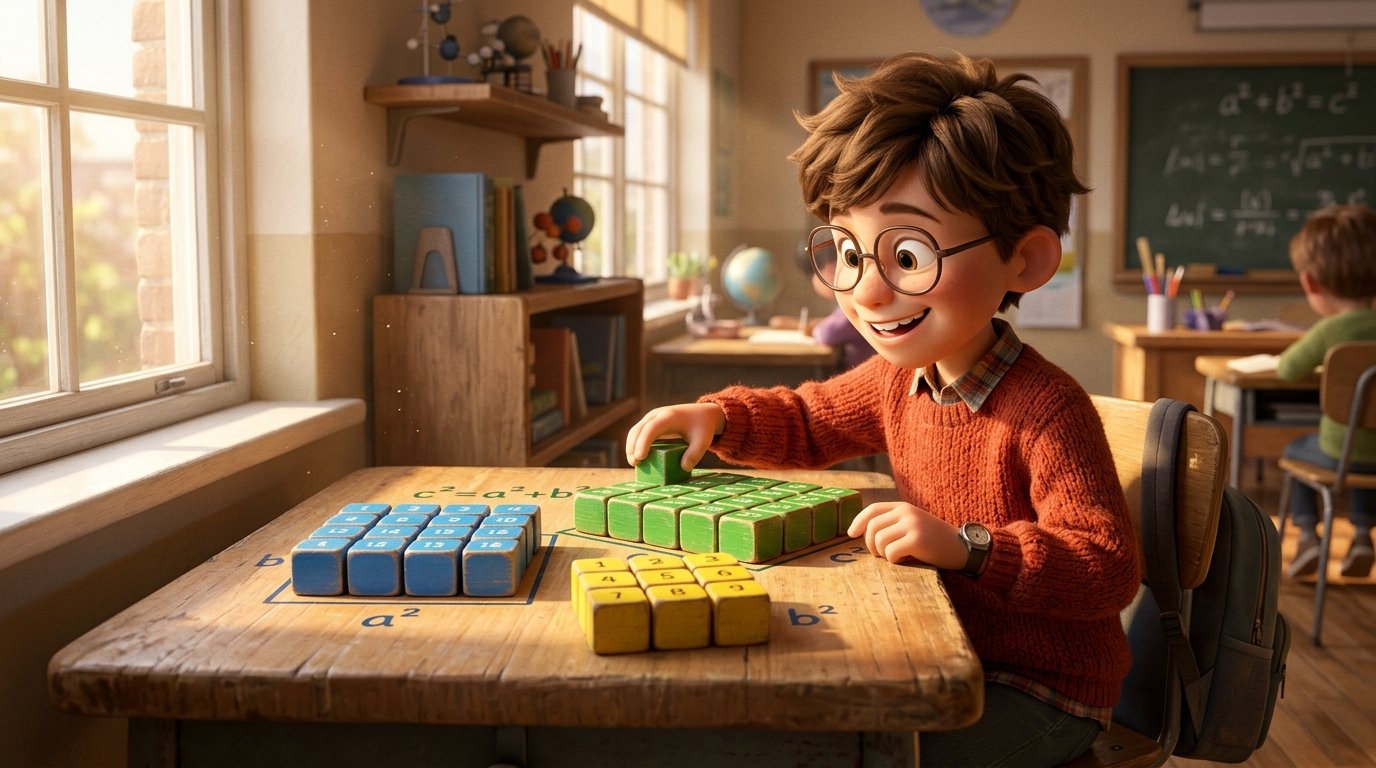
- A square built on the larger leg ($b^2$) is dissected into four congruent quadrilaterals by two perpendicular cuts passing through its center.
- Students take these four puzzle pieces along with the intact smaller square ($a^2$) and physically rearrange them inside the large square built on the hypotenuse ($c^2$).
- The five pieces fit together with zero gaps, zero overlap, and absolute geometric precision.
When an eighth grader slides those four dissected quadrilaterals and the tiny corner square into the hypotenuse frame and watches them lock together like a jigsaw puzzle, the conceptual barrier vanishes. They no longer need to "trust" the formula because their eyes and hands have verified the conservation of area.
2. Kinetic and Liquid Proof Demonstrations
Science and math museums around the world often feature an iconic acrylic wheel containing blue liquid divided into three square chambers surrounding a central right triangle. When the wheel is turned upside down, the fluid from the two smaller squares pours directly into the large hypotenuse square, filling it to the exact brim.
You can replicate this tactile fluid dynamic in the classroom without messy liquids by using dry sensory materials:
- Construct three shallow cardboard or plastic trays matching the dimensions of a 3-4-5 right triangle ($9\text{ cm}^2$, $16\text{ cm}^2$, and $25\text{ cm}^2$).
- Fill the two smaller trays with dry couscous, lentils, or colorful pony beads until flush with the rim.
- Have students pour the contents of both small squares into the large hypotenuse tray. The volume matches perfectly, providing immediate physical evidence of volumetric equivalence.
3. Four Scaffolded Pythagorean Tile Challenges
- The 3-4-5 Concrete Grid Puzzle: Provide younger students with square centimeter graph paper. Have them draw a right triangle with legs of 3 cm and 4 cm, draw the attached squares, count every individual square unit ($9 + 16 = 25$), and physically verify the 5 cm diagonal.
- The Chinese Chou Pei Suan Ching Proof: Introduce students to the ancient Chinese "broken bamboo" proof from 500 BCE, using four congruent right triangles arranged inside a large square to reveal the hypotenuse square in the negative space.
- President Garfield's Trapezoid Proof: Challenge advanced learners with the 1876 geometric proof authored by U.S. President James A. Garfield, which uses a single trapezoid split into three right triangles.
- Pythagorean Spiral of Theodorus: Guide students in constructing a beautiful nautilus shell spiral of consecutive square roots ($\sqrt{2}, \sqrt{3}, \sqrt{4}...$) on cardstock, coloring each triangle to create mathematical art.
Building Lifelong Mathematical Confidence
When students experience mathematical truth through spatial manipulation rather than mechanical drill, math anxiety is replaced by joyful curiosity. They begin to view formulas not as obstacles to fear, but as architectural blue prints waiting to be assembled.
Explore PuzzleNest's free Math & Geometry Printable Generators to create custom coordinate grids, tessellation mats, and spatial reasoning worksheets for your classroom today!