The Epidemic of Math Trauma in Modern Education
Ask a room full of successful adults if they feel confident writing an essay or speaking publicly, and many will raise their hands. Ask that same room if they consider themselves "a math person", and more than half will instantly recoil with nervous laughter, describing memories of timed flashcard drills, public chalkboard embarrassment, and overwhelming childhood panic. Math anxiety and mathematical imposter syndrome are rampant in our society.
The root cause of this widespread trauma lies in a historic pedagogical error: equating mathematical intelligence with procedural speed and rote formula execution. When math is treated as a race to perform memorized algorithms, students who think deeply, visually, or slowly internalize the false belief that they are fundamentally deficient. Low-floor, high-ceiling logic puzzles provide the antidote: inclusive mathematical challenges designed so that every child can easily enter, yet no child can easily exhaust.
1. Deconstructing the 'Low-Floor, High-Ceiling' Architecture
Pioneered by progressive mathematics educators like Seymour Papert and Jo Boaler, the concept of Low-Floor, High-Ceiling (LFHC) tasks is revolutionary in its simplicity:
- Low Floor: The initial problem requires minimal formal prerequisites. The rules can be explained in thirty seconds using everyday language, and every student—regardless of current academic tracking, language background, or disability status—can make immediate, legitimate progress.
- High Ceiling: While easy to start, the puzzle possesses profound mathematical depth, open-ended complexity, and multiple layers of extension that challenge the most advanced thinkers to generalize patterns, formulate algebraic conjectures, and prove principles.
- Wide Walls: Crucially, LFHC puzzles offer multiple pathways to solution: visual drawing, physical manipulatives, systematic trial-and-error, or formal symbolic algebra.
2. Iconic LFHC Puzzles: Number Pyramids and Kakuro Cross-Sums
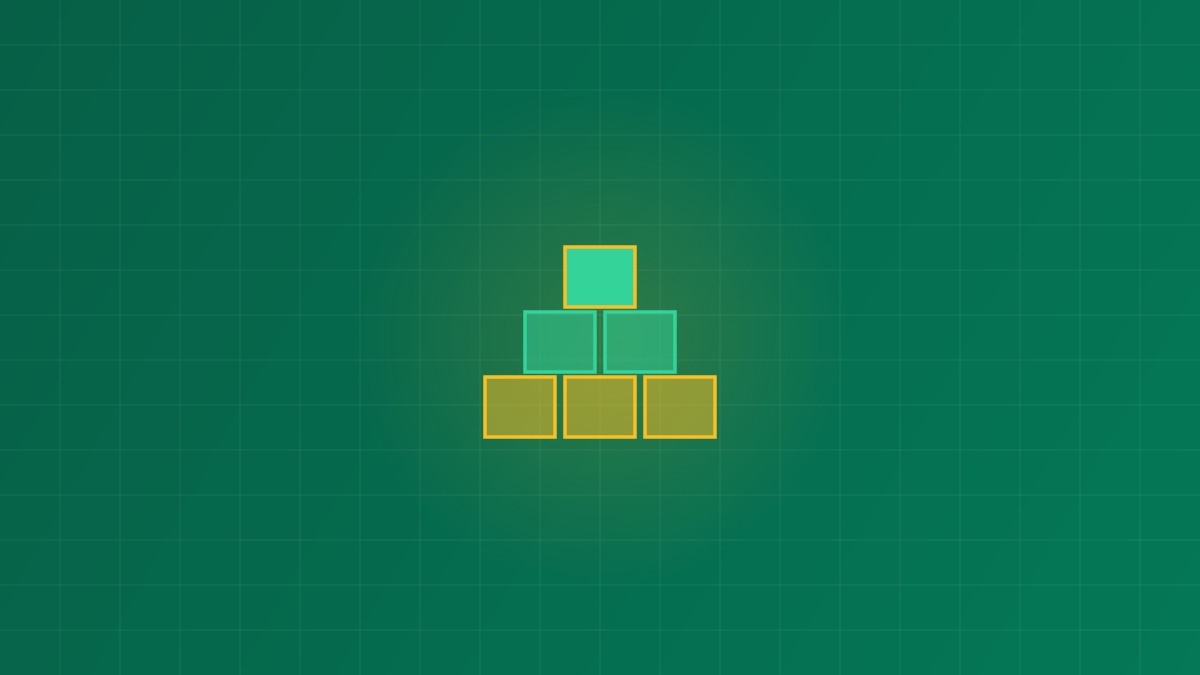
Consider a classic Number Addition Pyramid: a triangular stack of blocks where each brick is the sum of the two bricks directly beneath it:
- The Low Floor: Give a 2nd grader the bottom row of three numbers (e.g., 2, 5, 8). The child simply adds adjacent numbers to find the middle row ($2+5=7$, $5+8=13$) and adds those to find the top brick ($7+13=20$). Simple arithmetic practice that anyone can complete with unshakeable confidence.
- The High Ceiling: Give a 6th grader the top target number (e.g., 50) and challenge them to find the bottom three numbers using only prime digits, or challenge them to prove algebraically why the middle bottom number is always counted twice in the final sum ($Top = a + 2b + c$). Suddenly, students are exploring linear algebra, optimization, and algebraic proof without ever seeing an intimidating textbook variable!
"Mathematics is not about performing calculations fast; it is about looking at deep patterns with profound curiosity and feeling the quiet joy of discovery."
3. Healing Math Trauma Through Low-Stakes Exploration
When a student enters a classroom paralyzed by math anxiety, their working memory is physically hijacked by stress hormones. If handed a standard 30-problem calculation drill, their cognitive capacity drops by up to 50%.
LFHC puzzles lower this affective filter because they do not look like school tests. They look like games. There are no punitive point deductions for crossing out a number or testing a hypothesis that turns out to be incorrect; indeed, hitting an impasse is celebrated as valuable data collection! By shifting the classroom metric of success from "Who finished first?" to "Who found an interesting new way to think about this?", every student reclaims their rightful identity as a capable mathematician.
4. Four Strategies for Implementing LFHC Tasks
- The Silent Board Warm-Up: Write an open-ended number puzzle on the whiteboard as students enter the room (e.g., a magic square with missing numbers). For the first five minutes, no one speaks; students simply observe, think, and voluntarily walk up to fill in one logical cell.
- "Which One Doesn't Belong?" (WODB): Display four geometric shapes, numbers, or graphs. Challenge students to find a valid reason why each of the four could be considered the odd one out. Because every option has a correct argument, every student experiences success.
- Collaborative Vertical Whiteboards: Have students work in randomly assigned groups of three standing at vertical erasable whiteboards with only a single dry-erase marker between them, maximizing active verbal discourse and collaborative problem solving.
- Celebrate the Beautiful Mistake: Periodically showcase an elegant incorrect attempt on the document camera, asking the class: "What brilliant insight did this student have, and how can we build upon it to crack the puzzle?"
Transform your math classroom culture with PuzzleNest's free collection of Low-Floor, High-Ceiling Math Puzzles & Logic Printables today!