From Passionate Solver to Puzzle Architect
Millions of people around the world begin their morning with the tranquil ritual of solving a Sudoku puzzle. They scan rows for missing digits, test subtle intersecting cross-hatches, and celebrate the logical snap when a challenging grid reveals its solitary mathematical truth. Yet after solving dozens of puzzles, a captivating question naturally arises in curious minds: how are these puzzles actually constructed?
Crafting a valid, elegant Sudoku puzzle is an art form that harmonizes strict combinatorial mathematics with aesthetic architectural beauty. A poorly designed puzzle frustrates solvers with tedious trial-and-error guessing, multiple valid solutions, or chaotic clue distributions. In contrast, an expertly crafted Sudoku features graceful geometric symmetry, a strictly unique solution, and an intuitive deductive path. In this guide, we break down how to create your own Sudoku puzzles from scratch using both pencil-and-paper techniques and modern digital generators.
1. The Three Cardinal Laws of Valid Sudoku Design
Before placing a single number onto an empty grid, every puzzle author must respect three unbreakable mathematical axioms:
- Axiom 1 - Strict Uniqueness: A valid Sudoku must possess exactly one unique solution. If a puzzle allows two or more alternative number placements in any row or column, it is mathematically invalid.
- Axiom 2 - Pure Deductive Solvability: Every number must be reachable through deductive logic (scanning, naked singles, hidden pairs, pointing lines). Solvers should never be forced into blind "guessing" or bifurcated trial-and-error.
- Axiom 3 - The 17-Clue Theoretical Minimum: In 2012, an international team of mathematicians led by Gary McGuire utilized millions of supercomputer CPU hours to prove that no valid 9x9 Sudoku can exist with fewer than 17 given clues. Any puzzle with 16 or fewer clues mathematically yields at least two distinct solutions!
2. The Aesthetic Heritage of Rotational Grid Symmetry
When Maki Kaji—the revered founder of Japanese publisher Nikoli who popularized Sudoku globally in the 1980s—established the editorial standards for modern Sudoku, he instituted a strict aesthetic rule that remains the industry benchmark today: 180-Degree Rotational Symmetry.
"If you turn a professionally crafted Sudoku grid upside down, the physical pattern of given clue squares looks completely identical. Symmetry transforms an abstract matrix of numbers into a harmonious piece of visual art."
Common symmetrical patterns include:
- Central / 180-Degree Symmetry: If a clue exists at coordinate $(x, y)$, an identical paired clue must exist at $(10-x, 10-y)$. This is the gold standard for newspaper and book publishing.
- Diagonal / Axial Symmetry: Clues mirror across the main diagonal running from the top-left to bottom-right corner.
- Rotational 90-Degree Symmetry: Clues exhibit 4-fold rotational symmetry, creating pinwheel and starburst geometric motifs.
3. The 4-Step Reverse Engineering Construction Workflow
The secret to creating a flawless Sudoku puzzle is to work backwards from a fully solved grid:
- Step 1 - Generate a Complete Valid Master Grid: Fill all 81 squares of a 9x9 grid with a valid, solved Latin square arrangement respecting all row, column, and 3x3 block constraints.
- Step 2 - Map Symmetrical Clue Pairs: Choose a symmetrical pattern (such as rotational pairs). Mark which pairs of numbers will be preserved as given clues.
- Step 3 - Systematic Symmetrical Pruning: Remove symmetrical pairs of numbers one by one. After each removal, run an automated constraint-solver to verify that the remaining clues still produce exactly one unique solution.
- Step 4 - Classify Difficulty by Solving Techniques: If the puzzle can be completely solved using only single-candidate scanning, classify it as Easy. If it requires hidden subsets or box-line reduction, classify it as Medium. Puzzles requiring X-Wings, Swordfish, or XY-Wings represent Hard and Expert tiers.
4. Designing Mini 4x4 and 6x6 Sudoku for Young Beginners
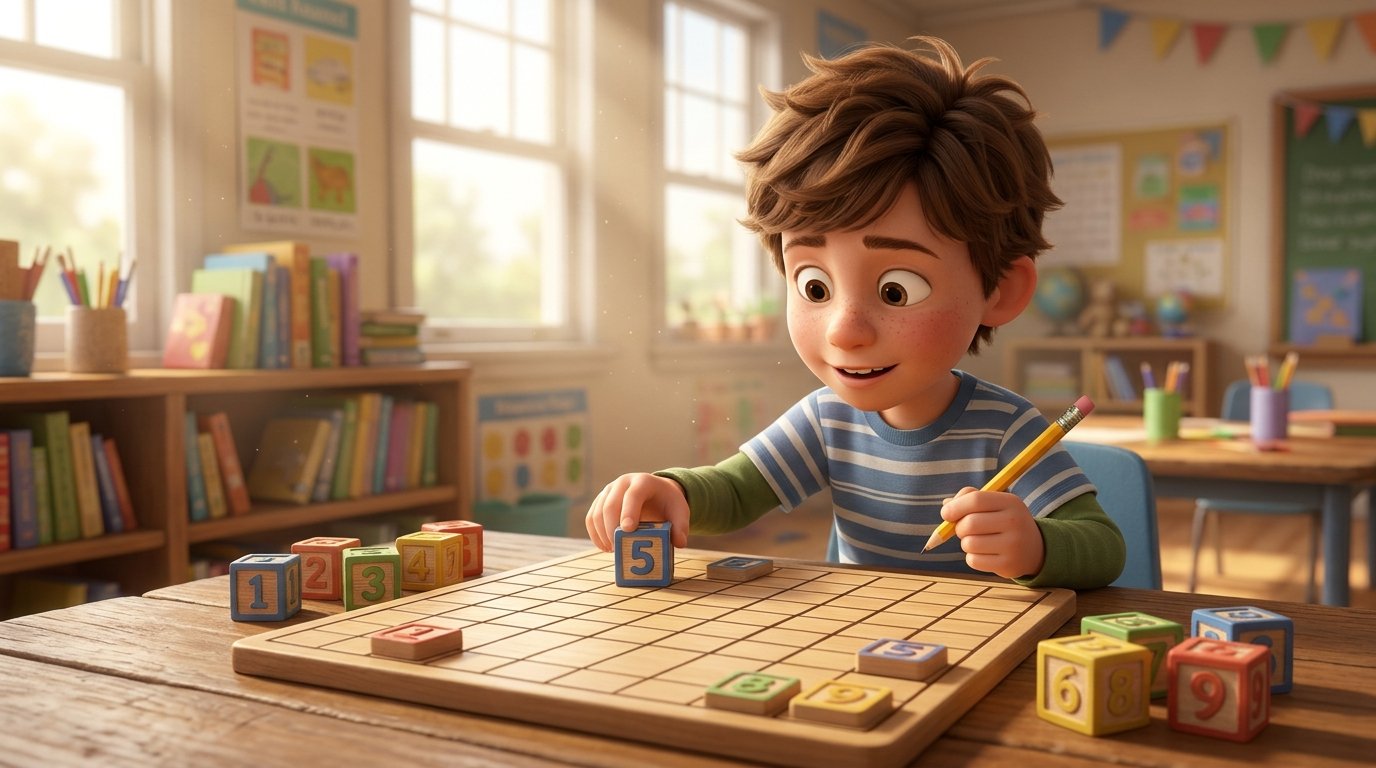
When introducing young children to puzzle authoring, standard 9x9 grids can be intimidating. Start with scaffolded mini-grids:
- 4x4 Mini Sudoku: Uses digits 1 through 4 divided into four 2x2 quadrants. Excellent for kindergarten and first-grade classrooms to teach row and column scanning.
- 6x6 Junior Sudoku: Uses digits 1 through 6 divided into six 2x3 blocks. A perfect bridge that introduces multi-digit deduction without overwhelming working memory.
5. Classroom Activity: "Become the Puzzle Master"
Challenge middle school math students to author their own 4x4 or 6x6 Sudoku puzzles for their peers. Students discover that removing too many numbers breaks the puzzle into multiple solutions, while removing too few makes it trivial. This hands-on balancing act develops profound appreciation for constraint satisfaction and mathematical proof.
Generate Custom Sudoku Puzzles in Seconds
Whether you are designing puzzle books for publication, crafting classroom worksheets, or enjoying casual brain fitness, custom Sudoku creation offers endless intellectual rewards.
Create, customize, and print your own custom 4x4, 6x6, and 9x9 puzzles today on PuzzleNest's Free Online Sudoku Maker & Generator!