Nature's Secret Code: The Numbers Behind Sunflowers, Pinecones, and Shells
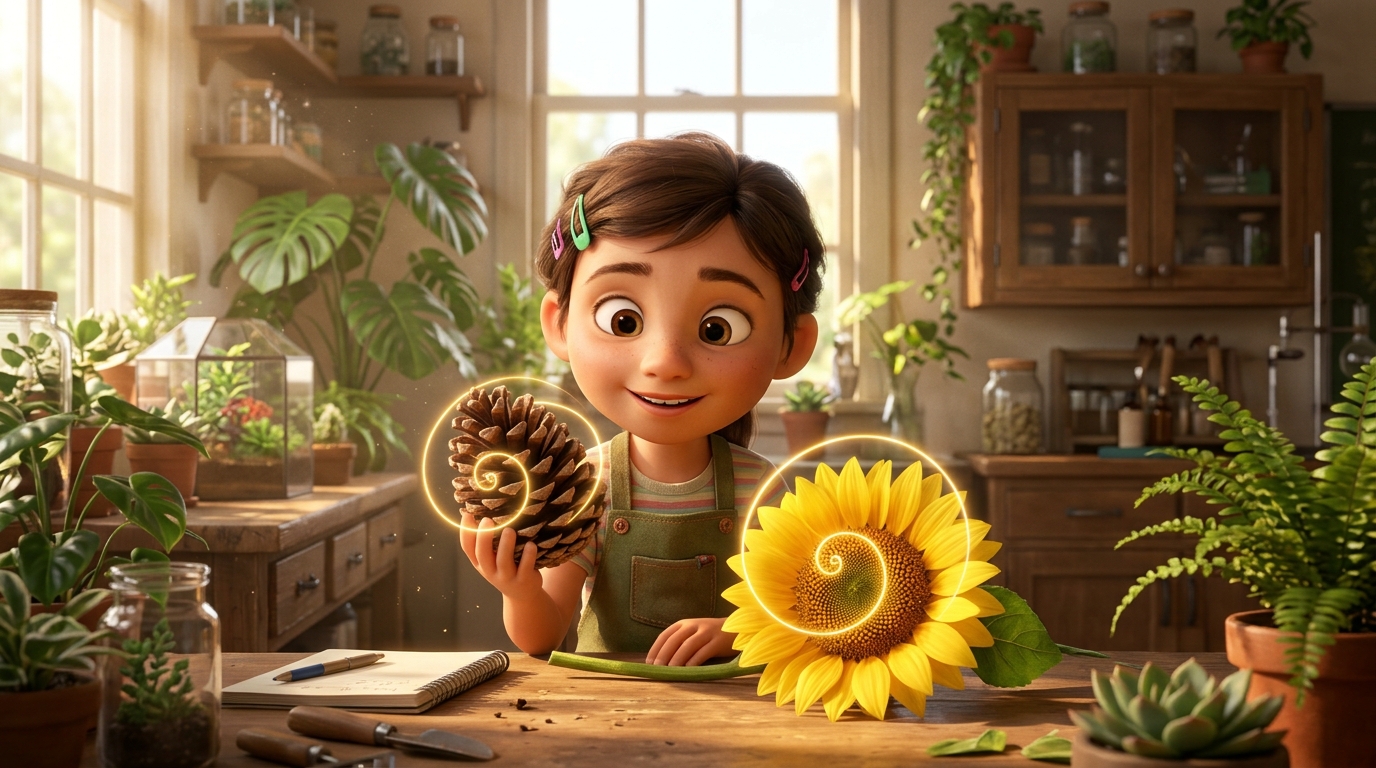
When young students ask, "When will I ever use math in real life?", there is no more inspiring answer than pointing to the natural world. Look closely at the spiral arrangement of seeds in a sunflower head, the interlocking scales of a pinecone, the unfurling fronds of a fiddlehead fern, or the chambered shell of a nautilus. Beneath their organic beauty lies a single, elegant numerical sequence discovered in 1202 by the Italian mathematician Leonardo of Pisa: The Fibonacci Sequence.
Introducing children to the Fibonacci sequence (1, 1, 2, 3, 5, 8, 13, 21...) through spiral mazes and geometric tile puzzles bridges the gap between arithmetic calculation and awe-inspiring scientific discovery. By tracing and constructing these logarithmic spirals, students witness math not as an invention of textbooks, but as the living architectural blueprint of the universe.
1. The Additive Law: How Simple Addition Builds Infinite Spirals
The mathematical rule governing the Fibonacci sequence is remarkably simple, making it accessible even to 1st and 2nd graders: every number is the sum of the two preceding numbers ($0 + 1 = 1$, $1 + 1 = 2$, $1 + 2 = 3$, $2 + 3 = 5$, $3 + 5 = 8$, and so on).
In a Fibonacci square-tiling puzzle, children begin with two tiny adjacent 1x1 squares on grid paper. Beneath them, they draw a 2x2 square ($1+1$). Alongside them, a 3x3 square ($1+2$). Then a 5x5 square ($2+3$), an 8x8 square ($3+5$), and a 13x13 square ($5+8$). When children take a colored pencil and draw a continuous sweeping quarter-circle arc through each nested square, an exquisite logarithmic golden spiral emerges before their eyes.
2. Botanical Investigations: Pinecones, Daisies, and Romanesco Broccoli
Transforming mathematical theory into experiential science requires hands-on botanical specimens. Bring real natural artifacts into the classroom or living room and challenge children to count spirals:
- Pinecone Bracts: Children will discover that pinecone scales spiral in two opposing directions. Counting the steep clockwise spirals typically reveals 8 rows, while the gentler counter-clockwise spirals reveal 13—two consecutive Fibonacci numbers!
- Sunflower Floret Spirals: Large sunflower heads exhibit 34 spirals winding one way and 55 winding the other, or 55 and 89 in giant varieties.
- Romanesco Broccoli: This miraculous vegetable is a natural 3D fractal where each miniature bud is an identical miniature logarithmic cone composed of Fibonacci spirals.
"Mathematics is the alphabet with which nature has written the universe. When children trace the Fibonacci spiral, they are reading nature's native language."
3. Navigating Logarithmic Spiral Mazes
Standard geometric mazes follow linear grid paths with 90-degree right angles. Fibonacci spiral mazes, by contrast, present curved radial tracks where corridor widths expand exponentially according to the Golden Ratio ($phi approx 1.618$).
Navigating these expanding curved corridors requires continuous adjustments in pencil pressure, fine-motor trajectory control, and polar spatial orientation. Students cannot rely on rigid rectilinear shortcuts; they must track radial curves from the outer perimeter into the golden center, cultivating focused patience and somatic flow.
4. Four Captivating Fibonacci Studio Activities
- The Fibonacci Tree Branching Diagram: Have students draw a stylized tree where a single trunk grows for one year, produces a single branch, and then each older branch splits annually while younger branches mature. Counting branches year-by-year produces the sequence: 1, 2, 3, 5, 8, 13.
- Golden Ratio Caliper Construction: Build simple 3-legged wooden or cardboard proportional calipers that maintain a 1:1.618 ratio when opened, allowing kids to measure everyday objects, furniture, and leaves to test for golden proportions.
- Fibonacci Rhythm Music Experiment: Tap rhythms or play notes on a xylophone using Fibonacci beat lengths (1 beat, 1 beat, 2 beats, 3 beats, 5 beats) to explore mathematical tempo in musical composition.
- Nature Scavenger Hunt Worksheets: Give students checklists to find plants in their school garden or local park with 3 petals (lilies), 5 petals (buttercups), 8 petals (delphiniums), or 13 petals (marigolds).
Explore our free Nature Math & Spiral Maze Worksheets on PuzzleNest to bring the magic of the Golden Ratio to your students today!