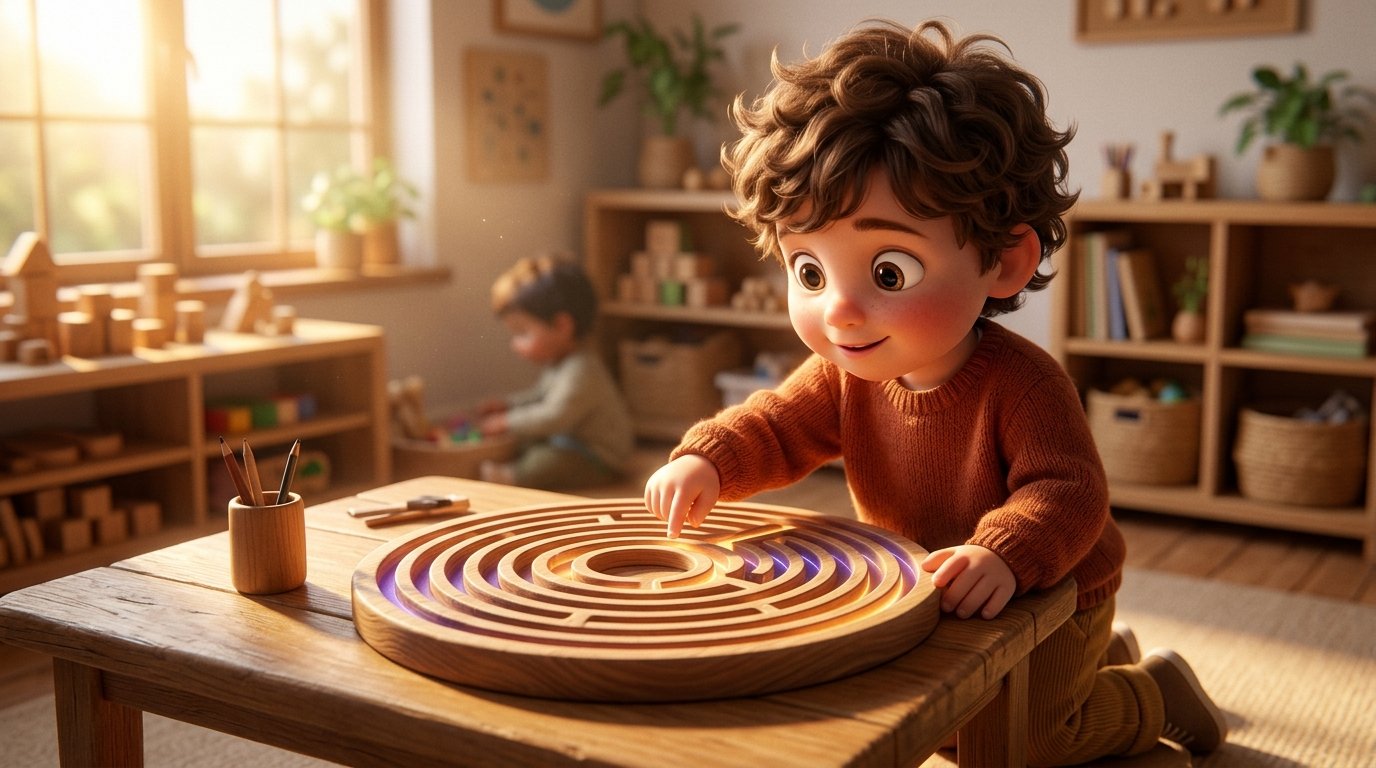
Cartesian Grids vs. Polar Coordinates: The Cognitive Shift in Maze Solving
When most people picture a printed paper maze, they visualize a standard rectangular grid: straight orthogonal corridors meeting at rigid 90-degree right angles, bounded by a square outer border. While orthogonal mazes are fantastic tools for developing linear fine motor tracking, the human visual system processes curves, arcs, and concentric circles through an entirely different cognitive mechanism.
Enter the radial labyrinth—a geometric masterpiece with roots stretching back thousands of years to ancient Cretan stone carvings and cathedral pavement stones like the famous 12th-century labyrinth at Chartres Cathedral. Today, modern circular maze generators allow educators and puzzle designers to harness polar coordinate mathematics to construct mesmerizing, concentric labyrinth pathways that challenge spatial orientation and predictive problem solving in young learners.
1. The Geometry of Concentric Rings and Angular Sectors
To understand why circular mazes feel fundamentally different to solve, we must examine the underlying coordinate geometry:
- Cartesian Grid Mazes: Every cell occupies a uniform $(x, y)$ coordinate. The distance between adjacent walls remains constant whether a solver is in the top-left corner or the dead center.
- Polar Coordinate Mazes: Cells are defined by radius $r$ (the distance from the origin center) and angle $\theta$ (the angular position along the circle). As the radius increases from the core toward the outer rim, the circumference of each consecutive ring expands according to $C = 2\pi r$.
This expanding circumference means that outer concentric corridors are significantly wider than interior rings. A child navigating a circular maze must constantly recalibrate their visual scale—discovering that an angular turn of 45 degrees covers a tiny distance near the core, but spans a massive curving journey along the outer perimeter!
2. Algorithmic Generation: Polar Recursive Backtracking & Tree Maze Algorithms
Creating a balanced circular maze requires specialized pathfinding algorithms that prevent the center rings from becoming overly congested while ensuring outer corridors do not become sparse. The most effective approach utilizes Polar Recursive Backtracking coupled with Spanning Tree Algorithms (such as randomized Kruskal's or Prim's algorithm adapted for polar graphs):
- Concentric Ring Subdivision: To maintain consistent cell aspect ratios, the algorithm periodically doubles the number of angular subdivisions as the radius expands outward (e.g., 8 cells in Ring 1, 16 in Ring 2, 32 in Ring 4).
- Tree Graph Connectivity: The path generator treats every cell as a node in a polar graph. By carving walls between adjacent radial and concentric neighbors, the algorithm builds a spanning tree containing zero closed loops and exactly one unique valid pathway from the outer entrance to the sacred central core.
- Dead End Branching: Sub-branches radiate outward and inward like fractal tree limbs, requiring solvers to mentally predict whether an inner passage will dead-end against a concentric ring barrier.
3. Sensory Benefits: Centripetal Focus and Calming Rhythmic Eye Tracking
Beyond mathematical theory, circular mazes offer profound neurological and emotional benefits for children, particularly those prone to attention fatigue or sensory overstimulation:
"Curving concentric pathways invite smooth, continuous saccadic eye movements. While angular mazes force abrupt, jerky visual halts at every corner, circular mazes encourage a flowing, rhythmic gaze that naturally induces alpha-wave relaxation."
This centripetal motion—moving progressively from the chaotic outer perimeter toward a quiet, centered bullseye—mirrors ancient meditative traditions. Occupational therapists frequently utilize circular tracing labyrinths as calming self-regulation tools for children with ADHD, autism, or emotional dysregulation before transitioning into focused academic tasks.
4. Classroom Geometry Activities: Radians, Chords, and Circumference
Elementary and middle school math teachers can turn circular maze worksheets into interactive geometry labs:
- The String Circumference Challenge: Have students take a length of colorful yarn and trace the longest curving outer ring of a circular maze, then measure the yarn against a ruler to physically verify $C = \pi d$.
- Degree vs. Radian Navigation: Challenge eighth graders to record their maze route using navigational directions: "Enter at 0 degrees, advance inward 3 rings, rotate counterclockwise 90 degrees ($\pi/2$ radians), then descend to the center."
- Concentric Ring Color Coding: Have students color each concentric level with a different gradient shade (from deep purple on the outside to glowing yellow at the core), creating stunning geometric optical art.
5. Differentiating Difficulty: Adjusting Radius Steps and Barrier Density
When generating circular mazes for varied age groups, adjust your generator parameters accordingly:
- Beginners (Ages 5–7): 4 to 6 concentric rings with wide corridors and minimal dead ends. Use bold center icons (like a smiling star or treasure chest) to provide a clear visual target.
- Intermediate (Ages 8–11): 8 to 12 concentric rings with alternating radial walls and false concentric loops that require backward tracking.
- Advanced Enthusiasts: 16+ rings with high barrier density, multiple deceptive concentric channels, and dual entry-exit challenges.
Bring Circular Labyrinths to Your Classroom
Introducing non-traditional geometry through playful, hands-on puzzles expands children's spatial imagination and demonstrates that mathematics is an art form full of harmony and beauty.
Generate custom circular, rectangular, and hexagonal labyrinths today on PuzzleNest's Free Online Maze Generator—complete with adjustable difficulty and instant printable PDF solutions!