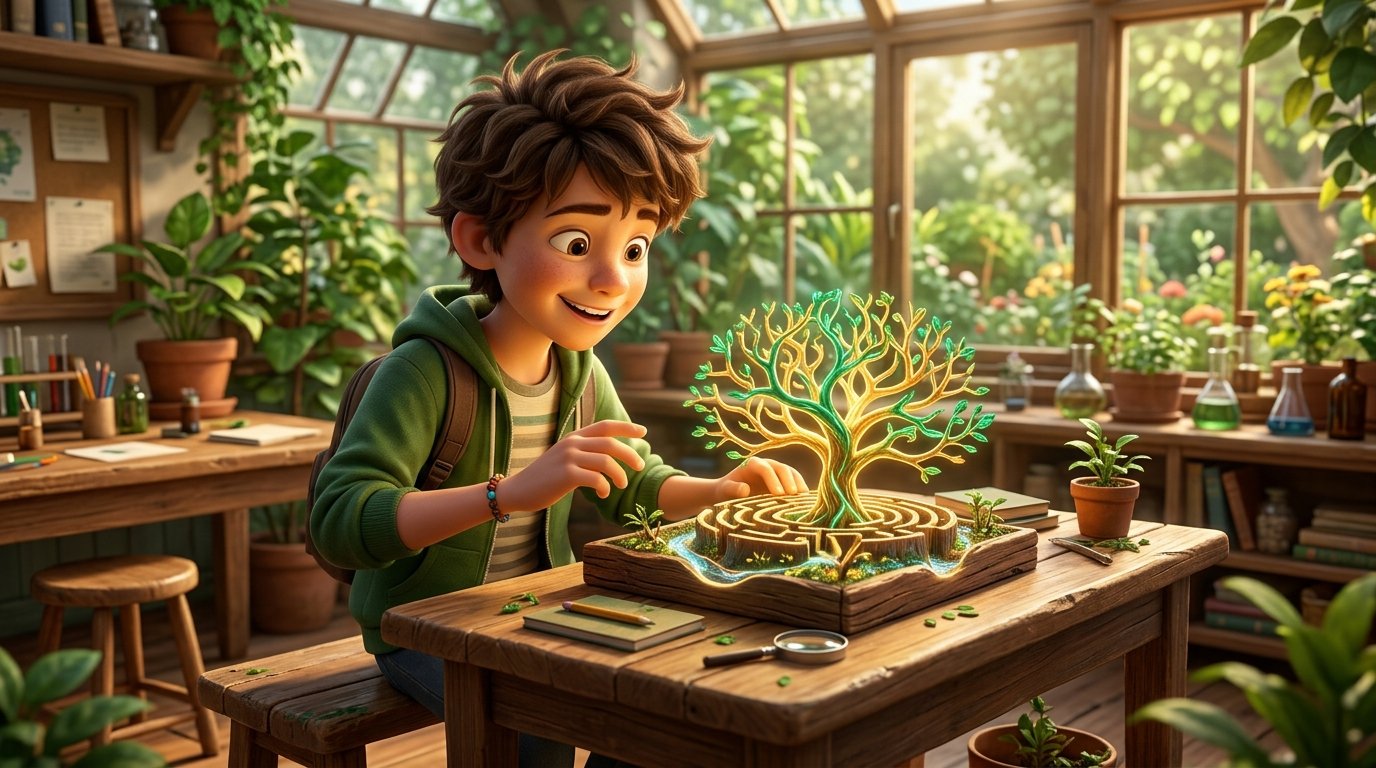
Nature as the Master Maze Architect
Step into a sunlit forest and look upward through the canopy of a towering oak tree: you are gazing at an extraordinary, living labyrinth. Follow the mighty trunk upward as it bifurcates into two main limbs, watch each limb fork into five branches, each branch divide into dozens of twigs, and each twig branch out into the microscopic vascular veins of an individual leaf. From the sprawling delta of the Amazon River seen from space to the branching bronchial pathways inside the human lungs and the jagged fractal forks of a lightning bolt, nature is governed by the mathematics of branching.
In computer science, one of the most foundational techniques for procedurally generating labyrinths is the tree maze algorithm (most notably binary tree and spanning tree graph models). By connecting algorithm design to natural botanical and geological structures, educators can transform an abstract coding lesson into an awe-inspiring interdisciplinary STEM inquiry. In this guide, we unpack the mathematical mechanics of binary tree mazes, explore nature's dendritic fractals, and share hands-on classroom activities.
1. The Binary Tree Maze Algorithm: Elegant Simplicity in Action
Among all computer maze generators, the Binary Tree Algorithm is celebrated as the simplest and fastest algorithm known. It requires virtually zero memory storage and can be executed cell-by-cell in a single linear pass:
- For every single cell $(x, y)$ in a grid, the algorithm looks at exactly two options: carve a wall to the North, or carve a wall to the East.
- The computer flips a coin (50/50 probability). If heads, it carves North; if tails, it carves East.
- For cells on the northernmost boundary, it always carves East. For cells on the easternmost boundary, it always carves North.
- Once every cell has executed its single coin flip, a complete, fully connected perfect maze is born!
2. The "Diagonal Bias" and Fractal Branching Behavior
Because every cell in a binary tree maze is strictly restricted to carving North or East, the resulting labyrinth exhibits a fascinating mathematical phenomenon known as diagonal texture bias:
"The northern and eastern perimeter corridors are completely unobstructed straight freeways! Furthermore, from any point in the maze, following a North or East corridor will inevitably guide you toward the top-right corner without a single dead end—mirroring the way rainwater falling anywhere in a river basin inevitably flows downstream toward the ocean delta."
This unidirectional flow makes binary tree mazes an unmatched visual model for teaching students about hydrology, drainage divides, and gravitational flow networks.
3. Dendritic Patterns Across the Sciences
In geology, biology, and physics, tree-like branching networks are known as dendritic structures (from the ancient Greek dendron, meaning "tree"). Nature converges upon dendritic branching because it represents the mathematically optimal configuration for maximizing surface area while minimizing transport resistance:
- Botanical Trees: Maximize leaf surface area to capture sunlight while transporting sap from a single root stem.
- Human Circulatory System: The aorta branches repeatedly into arteries, arterioles, and capillaries so that blood cells can deliver oxygen to trillions of individual cells with minimal pumping energy.
- Neural Dendrites in the Brain: A single neuron extends branching dendrites to connect with up to 10,000 neighboring synapses, forming the intricate neural labyrinths that power human thought and memory.
- Lightning Discharge: Electrical current seeks the path of least electrical resistance through ionized air, branching in fractal Lichtenberg figures.
4. 3 Hands-On Classroom STEM Investigations
Connect branching algorithms to living science through these cross-curricular projects:
- The Fibonacci Leaf-Branching Ratio: Have students collect fallen tree branches from the schoolyard. Trace and count the branching bifurcations at each level, analyzing how branch angles and lengths follow golden ratio and Fibonacci sequences.
- The Celery & Food Coloring Capillary Maze: Place stalks of fresh celery into glasses of water colored with red and blue food dye. Over 24 hours, students observe the dye ascending through the branching xylem vascular network, mapping the biological maze with magnifying glasses.
- Fractal Lichtenberg Art with Watercolors: Have students paint a branching tree trunk on wet watercolor paper using deep black ink. By blowing gently through a plastic drinking straw, the air current forces the wet ink to branch and fork naturally into thousands of delicate fractal twigs!
Synthesizing Computational Logic and Natural Wonder
When students understand that the same branching algorithm powering a printable paper maze also governs the rivers carved across continents and the neural networks firing in their own brains, mathematics ceases to be a sterile abstraction. It becomes the universal language of the cosmos.
Explore procedural mazes, circular labyrinths, and geometric worksheets today on PuzzleNest's Free Online Maze Generator!