The Beautiful Chaos of the Multi-Age Homeschool Classroom
Ask any homeschooling parent to describe their greatest daily operational challenge, and the answer is nearly unanimous: multi-grade management. How do you teach 7th-grade pre-algebra to your eldest child, guide your 2nd-grader through reading phonics, and keep an energetic 4-year-old toddler happily engaged and learning at the very same kitchen table without losing your sanity?
Traditional grade-level school curriculums are designed for segregated classrooms where 25 children share the exact same age. In a homeschool family, however, learning is naturally multi-generational. Adaptive, tiered puzzle stations provide the ultimate pedagogical solution. By structuring a central thematic learning station that offers three distinct tiers of cognitive difficulty, siblings of vastly different ages can work side-by-side in peaceful, collaborative harmony.
1. The 3-Tiered Puzzle Station Framework
The core secret of an adaptive station is selecting a single unifying mathematical or literacy theme, and then providing three color-coded challenge bins:
- Green Tier (Early Childhood / Preschool): Concrete, sensory-rich manipulatives and foundational pattern matching. Focuses on gross fine-motor tracing, shape sorting, and visual recognition.
- Blue Tier (Primary / Elementary): Rule-based structured puzzles with clear arithmetic, spelling, or logic constraints. Focuses on independent execution and foundational mastery.
- Gold Tier (Upper Elementary / Middle School): Multi-step deductive logic, algebraic thinking, open-ended spatial design, and speed optimization. Focuses on higher-order reasoning.
2. Case Study in Action: The Multi-Age Tangram Station
Consider how a single set of wooden tangrams or printable geometric tans adapts across three age groups simultaneously at the homeschool dining table:
- The 4-Year-Old (Green Tier): Uses a full-size color-coded tangram silhouette mat where the exact outline of each individual shape is clearly drawn. The toddler simply matches the physical wooden green triangle to the printed green triangle, mastering shape rotation, pincer grip, and spatial matching.
- The 8-Year-Old (Blue Tier): Receives an unsegmented solid black silhouette of a leaping rabbit. The child knows all seven pieces must be used, but must mentally rotate and test different geometric combinations to discover how to fill the shape.
- The 13-Year-Old (Gold Tier): Receives an algebraic area challenge: "If the small square tan has an area of 4 square centimeters, calculate the exact surface area and perimeter of the entire composite swan figure. Then prove mathematically how many unique convex polygons can be constructed using all seven pieces!"
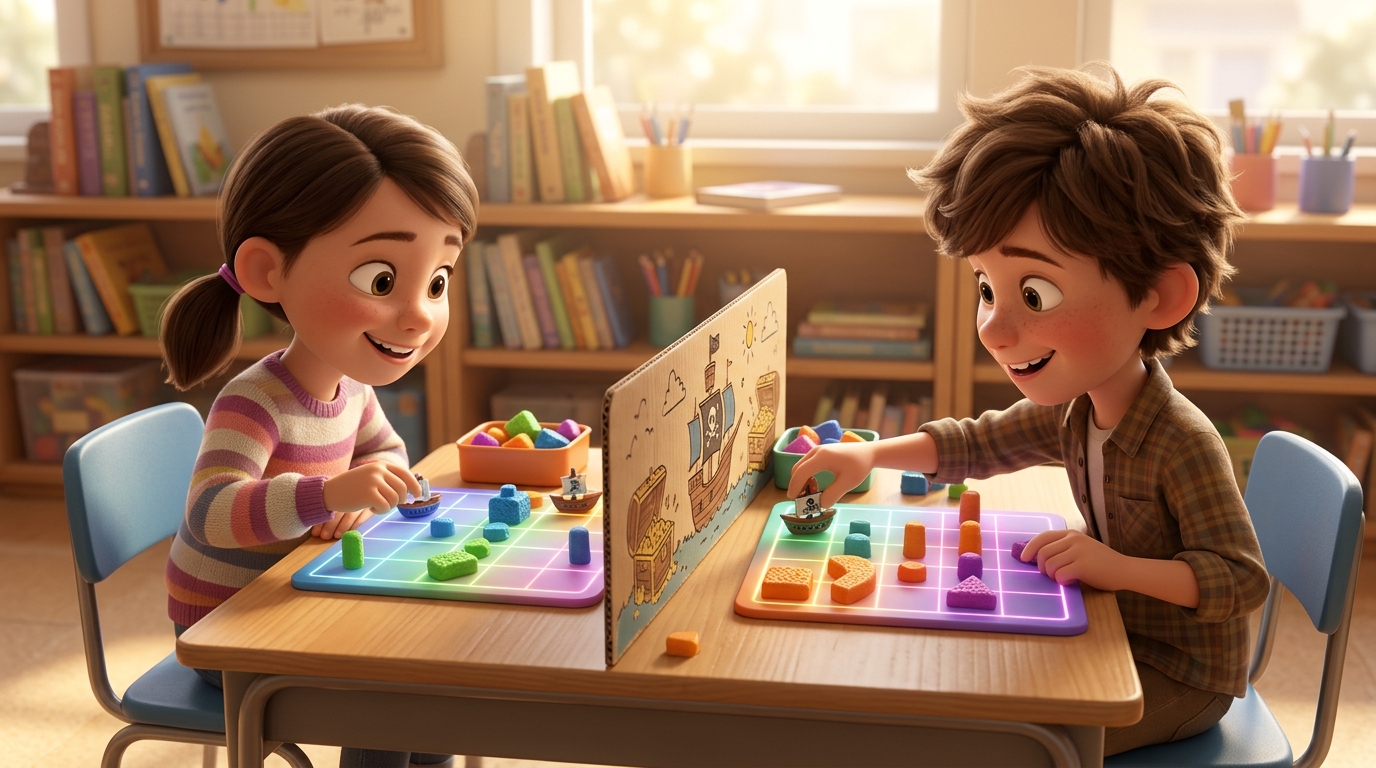
All three children are engaged in geometry at the same table, discussing spatial rotations together, while mom or dad rotates between them offering targeted encouragement.
"A home where children of different ages solve puzzles side-by-side is a home where older siblings become natural mentors and younger siblings absorb curiosity like sunlight."
3. Fostering Cooperative Sibling Mentorship
One of the greatest benefits of adaptive puzzle stations is the natural emergence of cross-age peer teaching. Educational research consistently proves that when an older child explains a concept to a younger sibling, the older child solidifies their own conceptual mastery far more deeply than through silent solo study.
Encourage older siblings to act as the "Puzzle Master" or "Game Judge" for their younger brother or sister: checking answers, offering gentle Socratic hints rather than spoiling solutions, and celebrating their sibling's breakthroughs. This transforms potential sibling rivalry into genuine collaborative pride.
4. Practical Storage and Rotation Tips for Busy Parents
- The 3-Drawer Rolling Cart: Use an inexpensive 3-drawer plastic rolling cart labeled Tier 1, Tier 2, and Tier 3. Stock each drawer with laminated puzzle sheets, dry-erase markers, and matching manipulatives on Sunday evening.
- The Weekly Puzzle of the Week Board: Mount a magnetic whiteboard in your homeschool room. Post a weekly logic riddle, cipher message, or math stumper with an envelope where children deposit their written hypotheses throughout the week.
- Independent "I'm Done, What's Next?" Bins: When an older child finishes their formal math lesson early while mom is nursing the baby, they know to automatically pull an independent challenge from the Gold Tier bin without interrupting.
- Friday Sibling Game Tournament: Dedicate Friday afternoon to cooperative board games, escape binders, and family puzzle challenges, ending the school week on a joyful, celebratory note.
Equip your multi-grade homeschool with free printable Differentiated Puzzle Packs & Adaptive Learning Mats on PuzzleNest today!